
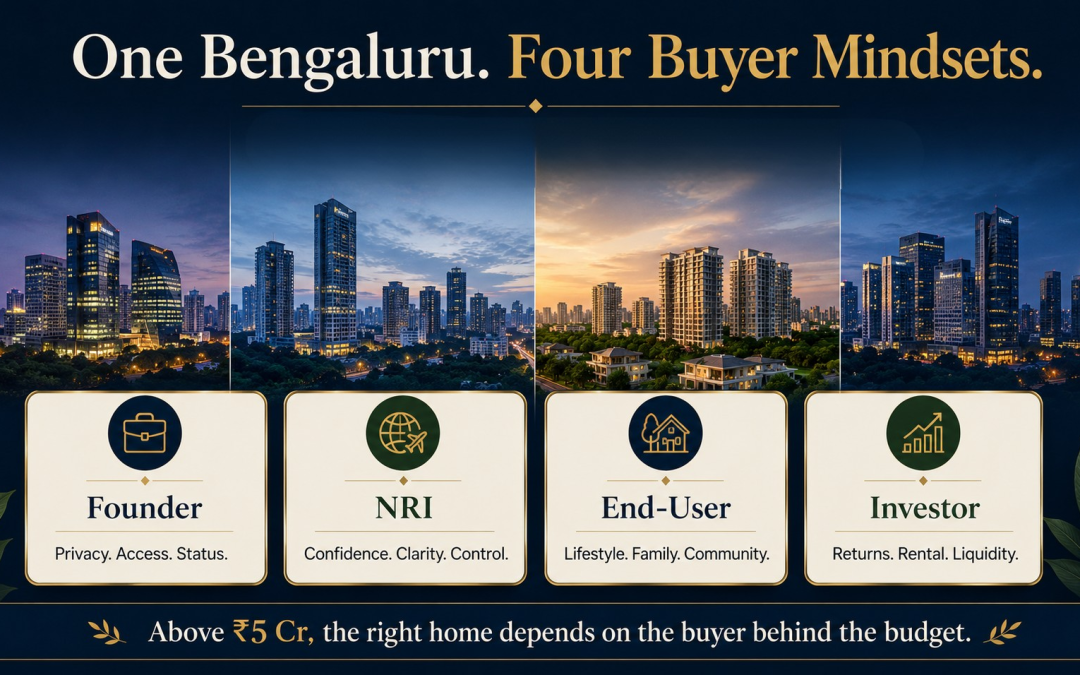
Bengaluru’s premium real estate market is no longer driven by one type of luxury buyer.
At ₹5 Cr and above, buyers are not simply asking:
“Which is the best property?”
They are asking very different questions.
A founder may ask:
“Does this home give me privacy, status and fast access to my work life?”
An NRI may ask:
“Can I buy this remotely with clean documentation and long-term control?”
An end-user may ask:
“Will this home work for my family for the next 10 years?”
An investor may ask:
“Will this asset appreciate, rent well and exit cleanly?”
Same city.
Same price band.
Completely different buying logic.
That is why premium home advisory in Bengaluru cannot be inventory-led.
It has to be persona-led.
Because above ₹5 Cr, the buyer is not just buying a home.
They are buying fit, confidence, privacy, liquidity and long-term control.
Why this matters in Bengaluru now
Bengaluru has moved from being only an IT-led housing market to a deeper premium ownership market.
The city now has multiple demand engines working together:
Startup wealth.
GCC and corporate leadership.
NRI capital.
Premium end-user upgrades.
Infrastructure-led micro-market growth.
Larger home preference.
Rental demand across employment corridors.
This has changed how buyers behave.
A ₹5 Cr buyer in Hebbal is not always the same as a ₹5 Cr buyer in Indiranagar.
A ₹10 Cr founder looking for privacy is not the same as a ₹10 Cr NRI looking for future family use.
A ₹6 Cr end-user buying for schools and commute is not the same as a ₹6 Cr investor buying for exit liquidity.
That is why the right advisory question is not:
“Which property is available?”
The better question is:
“Which buyer persona does this property truly fit?”
Premium buyer persona snapshot
| Buyer persona | Budget focus | Primary intent | Typical holding period | Most important decision lens |
|---|---|---|---|---|
| Founder | ₹8 Cr – ₹25 Cr+ | Privacy, status, convenience, wealth parking | 7–12 years | Does this home match my lifestyle, speed and identity? |
| NRI | ₹5 Cr – ₹15 Cr+ | Future family base, remote ownership, long-term asset | 5–10 years | Can I buy, manage and exit this cleanly from abroad? |
| End-user | ₹5 Cr – ₹10 Cr+ | Lifestyle upgrade, family living, community | 8–15 years | Will this work for my family’s daily life? |
| Investor | ₹5 Cr – ₹12 Cr+ | Appreciation, rental depth, exit liquidity | 4–8 years | Is this asset liquid, rentable and correctly priced? |
This table explains why a single sales pitch does not work for every premium buyer.
Each persona is solving a different problem.
So the shortlist, micro-market, pricing logic, negotiation strategy and post-purchase support must also be different.
Modelled budget midpoint by buyer persona
| Buyer persona | Budget range | Modelled midpoint |
|---|---|---|
| Founder | ₹8 Cr – ₹25 Cr+ | ₹16.5 Cr |
| NRI | ₹5 Cr – ₹15 Cr+ | ₹10 Cr |
| End-user | ₹5 Cr – ₹10 Cr+ | ₹7.5 Cr |
| Investor | ₹5 Cr – ₹12 Cr+ | ₹8.5 Cr |
1. Founder persona: buying privacy, speed and identity
The founder buyer is not just buying a residence.
They are buying a private operating base.
This persona usually values time, access, discretion and brand signalling.
For founders, a home is often connected to identity.
It should feel successful, but not loud.
It should be private, but not isolated.
It should be close enough to business corridors, airport routes or social zones, but still offer calm and exclusivity.
Founder buyers may look at central Bengaluru, Indiranagar, Koramangala, select CBD pockets, premium Hebbal-Jakkur towers, low-density residences, penthouses or villa-style products.
Their decision is usually not driven by the lowest price.
It is driven by fit.
They may ask:
Will this home protect my privacy?
Can I host family and close networks well?
Is the entry and exit discreet?
Does the address carry weight?
Will this still feel premium 10 years later?
Does the home reduce friction in my daily life?
For this buyer, the advisor’s role is not to send 20 options.
It is to filter noise.
The founder buyer needs a tight shortlist, strong pricing context, off-market awareness where possible, and a clear view on scarcity.
The wrong approach is to oversell amenities.
The right approach is to explain privacy, exclusivity, access, floor quality, community profile and long-term address strength.
Founder buyer matrix
| Decision factor | Importance level | Why it matters |
|---|---|---|
| Privacy | Very high | The home must feel protected and low-noise |
| Address value | Very high | Location becomes part of identity |
| Airport / business access | High | Time efficiency matters |
| Community profile | High | Peer environment matters |
| Rental yield | Low to moderate | Usually not the primary reason to buy |
| Exit value | Moderate to high | Capital preservation still matters |
| Customisation | High | Interiors and lifestyle fit are important |
| Post-purchase support | High | Founder buyers expect execution support |
The founder buyer is usually not asking for more options.
They are asking for better curation.
2. NRI persona: buying confidence from a distance
The NRI buyer is one of the most important premium buyer personas in Bengaluru.
But this buyer is also one of the most process-sensitive.
For an NRI, the property may be in Bengaluru, but the decision is often happening from Dubai, Singapore, London, New York, San Francisco or Australia.
That changes everything.
The NRI buyer may not be able to visit every site.
They may not be able to inspect the unit physically.
They may not understand local micro-market changes in real time.
They may need support with payment route, POA, registration, legal review, RERA check, tax planning, loan documentation and post-purchase management.
For NRIs, the advisor’s value is not only in showing premium homes.
It is in building trust.
A good advisor should help answer:
Is this asset legally clean?
Is the payment route compliant?
Can the property be managed after purchase?
Will this micro-market work for future family use?
Can the home be rented if plans change?
Will the asset be easy to resell later?
Who will inspect and manage the property on the ground?
This is why NRI buying should be advisory-led, not listing-led.
The NRI buyer needs a controlled process.
Not random links.
NRI buyer matrix
| Decision factor | Importance level | Why it matters |
|---|---|---|
| Legal clarity | Very high | Buyer is not physically present |
| RERA / documentation | Very high | Builds confidence before token |
| Payment route | Very high | Clean fund trail matters |
| Micro-market understanding | High | Prevents buying only by brand or brochure |
| Rental fallback | High | Useful if self-use is delayed |
| Property management | Very high | Ownership continues after registration |
| POA / registration support | High | Execution must be planned |
| Exit readiness | High | Future repatriation and resale matter |
For NRIs, the right property is only one part of the decision.
The right process is equally important.
3. End-user persona: buying daily life and family certainty
The end-user buyer above ₹5 Cr is usually upgrading life.
This buyer is not thinking only about returns.
They are thinking about the next 8 to 15 years of living.
For this buyer, the home must solve practical and emotional needs together.
Space.
Community.
School access.
Commute.
Safety.
Layout.
Balcony.
Natural light.
Amenities.
Maintenance quality.
Neighbourhood comfort.
Future family needs.
This buyer may look at North Bengaluru, Whitefield, ORR-side pockets, Sarjapur Road, South Bengaluru premium pockets, Indiranagar, Koramangala or select central neighbourhoods depending on work, school and family lifestyle.
The end-user buyer is often the most detail-oriented.
They will ask:
Will my family actually enjoy living here?
Is the layout efficient?
Is the community mature?
How much will maintenance cost?
How far is school or office really?
Is the commute manageable during peak hours?
Will this home still work when my family needs change?
For this persona, the advisor needs to act like a decision partner.
Not a salesperson.
The right advisory approach is to compare daily-life fit across options.
A project may look premium but still fail if the commute is poor, the layout is inefficient, or the community profile does not match the family.
End-user buyer matrix
| Decision factor | Importance level | Why it matters |
|---|---|---|
| Livability | Very high | This is the main purpose of purchase |
| Layout efficiency | Very high | Poor planning affects daily comfort |
| School / office access | High | Daily commute defines satisfaction |
| Community quality | High | Long-term living depends on people and culture |
| Amenities | Moderate to high | Useful only if maintained well |
| Appreciation | Moderate | Important, but not the primary trigger |
| Rental yield | Low | Usually secondary |
| Maintenance cost | High | Impacts long-term comfort |
End-users do not just buy the home.
They buy the lifestyle system around the home.
4. Investor persona: buying entry price, demand and exit
The investor buyer above ₹5 Cr is different from the end-user.
This buyer may like the home, but they are mainly studying the asset.
The investor wants to know:
Is the price right?
Is the market deep?
Will it rent?
Will it appreciate?
Who buys it later?
Is the supply pipeline controlled?
Is there an infrastructure trigger?
Is the product too niche?
Can the asset exit within a reasonable time?
In Bengaluru, premium investors often study Hebbal, Jakkur, Whitefield, ORR-side markets, Sarjapur Road, Devanahalli and select central resale opportunities.
The investor is not only looking for luxury.
They are looking for market depth.
A beautiful home with weak resale liquidity may not be attractive.
A slightly less glamorous product in a stronger demand corridor may be a better investment.
This is where advisory becomes critical.
The advisor must help separate emotional luxury from investment-grade real estate.
The investor buyer needs data, not decoration.
Investor buyer matrix
| Decision factor | Importance level | Why it matters |
|---|---|---|
| Entry price | Very high | Returns are shaped at purchase |
| Appreciation potential | Very high | Main investment driver |
| Rental depth | High | Creates holding income |
| Exit liquidity | Very high | Determines future flexibility |
| Infrastructure trigger | High | Can support long-term price growth |
| Supply risk | High | Too much future supply can weaken returns |
| Developer credibility | High | Impacts resale confidence |
| Lifestyle appeal | Moderate | Helps rentability and resale, but is not enough |
For investors, a property must not only look premium.
It must behave like a strong asset.
Buyer persona vs micro-market fit
| Micro-market / corridor | Founder | NRI | End-user | Investor | Why it works |
|---|---|---|---|---|---|
| Indiranagar | High | Moderate | High | Moderate | Lifestyle, centrality, scarcity |
| Koramangala | High | Moderate | High | Moderate | Founder ecosystem, social infrastructure |
| CBD / Central Bengaluru | High | High | Moderate | High | Scarcity, prestige, limited supply |
| Hebbal | High | High | High | High | Airport access, premium towers, growth |
| Jakkur | Moderate | High | High | High | Larger homes, calmer residential profile |
| Whitefield | Moderate | High | High | High | IT/GCC demand, rental depth |
| ORR-side markets | High | High | High | High | Employment corridor strength |
| Sarjapur Road | Moderate | High | High | High | Future growth and end-user depth |
| Devanahalli | Moderate | High | Moderate | High | Airport-led long-term growth |
| Yelahanka | Moderate | High | High | Moderate | Lifestyle, open spaces, family use |
This is where many buyers make a mistake.
They choose a micro-market because it is popular.
But the right question is:
Popular for whom?
A founder, NRI, end-user and investor may all like Hebbal.
But each one likes it for a different reason.
That reason must be understood before shortlisting.
Buyer intent split by persona
| Persona | Self-use | Investment / appreciation | Rental income | Wealth parking / optionality |
|---|---|---|---|---|
| Founder | 45% | 20% | 5% | 30% |
| NRI | 35% | 25% | 15% | 25% |
| End-user | 80% | 10% | 5% | 5% |
| Investor | 10% | 60% | 20% | 10% |
Decision weightage by buyer persona.
| Decision factor | Founder | NRI | End-user | Investor |
|---|---|---|---|---|
| Privacy / exclusivity | 95 | 55 | 45 | 30 |
| Legal clarity | 65 | 95 | 75 | 80 |
| Micro-market fit | 80 | 85 | 90 | 90 |
| Rental depth | 35 | 70 | 35 | 90 |
| Exit liquidity | 70 | 80 | 60 | 95 |
| Lifestyle fit | 85 | 75 | 95 | 55 |
| Payment / tax structure | 55 | 95 | 50 | 75 |
| Property management | 70 | 95 | 50 | 75 |
Financing and ownership lens
| Persona | Funding style | Finance sensitivity | Key ownership concern |
|---|---|---|---|
| Founder | Mostly equity-led or strategic debt | Low to moderate | Privacy, title clarity, long-term capital parking |
| NRI | Equity or NRI home loan | Moderate | Clean payment route, POA, repatriation, management |
| End-user | Equity + home loan | Moderate to high | EMI comfort, family suitability, possession confidence |
| Investor | Equity-led or low leverage | Moderate | Entry price, tax, rental yield, exit timing |
This is important because funding style changes behaviour.
A founder may move faster if the asset feels rare.
An NRI may slow down until documentation is clear.
An end-user may compare more deeply because the family will live there.
An investor may negotiate harder because entry price shapes returns.
One city.
Four different capital behaviours.
Real estate impact: what this means for advisory
The biggest mistake in premium real estate is treating every buyer the same.
Above ₹5 Cr, the buyer’s psychology matters as much as the property.
A founder may reject a great home if it lacks privacy.
An NRI may reject a great project if the process feels unclear.
An end-user may reject a high-return asset if the commute is poor.
An investor may reject a beautiful home if the exit buyer pool is too narrow.
That is why Circled Plus should not only curate luxury homes.
It should curate by buyer intent.
The right advisory flow should ask:
Who is the buyer?
What is the primary use case?
What is the time horizon?
How important is rental income?
How important is resale liquidity?
Is the buyer local or remote?
Does the buyer need post-purchase management?
What micro-market best matches this intent?
Once these questions are answered, the shortlist becomes sharper.
And the buyer feels more confident.
Buyer-persona advisory playbook
| Persona | What to lead with | What to avoid | What converts |
|---|---|---|---|
| Founder | Privacy, access, scarcity, discretion | Generic amenity pitch | Curated shortlist, discreet viewings, premium negotiation |
| NRI | Trust, process, documentation, remote control | Rushing token without clarity | Legal/RERA clarity, payment route, POA, inspection support |
| End-user | Lifestyle, layout, schools, commute, community | Pure investment pitch | Family-fit comparison, site experience, possession confidence |
| Investor | Entry price, demand, rent, exit, infrastructure | Emotional luxury language | Data-led investment memo, rental view, resale strategy |
This is the real value of advisory.
Not just showing homes.
Helping the buyer understand which homes make sense for their persona.
Final Thought
Bengaluru’s ₹5 Cr+ market is not one market.
It is four markets operating at the same time.
The founder market.
The NRI market.
The end-user market.
The investor market.
Each buyer sees value differently.
For one buyer, value is privacy.
For another, it is documentation.
For another, it is family comfort.
For another, it is exit liquidity.
That is why premium buying cannot be reduced to a list of available homes.
At this level, the decision needs a sharper lens.
The right home must match the buyer’s budget, lifestyle, risk profile, holding period, micro-market logic and future plan.
That is where good advisory changes the outcome.
Because above ₹5 Cr, serious buyers do not need more listings.
They need better matching.
Better verification.
Better negotiation.
Better post-purchase control.
And most importantly, better judgment.
In Bengaluru’s premium market, the smartest buyers are not just asking:
“What can I buy?”
They are asking:
“What fits me best?”
That is where the right property journey begins.