
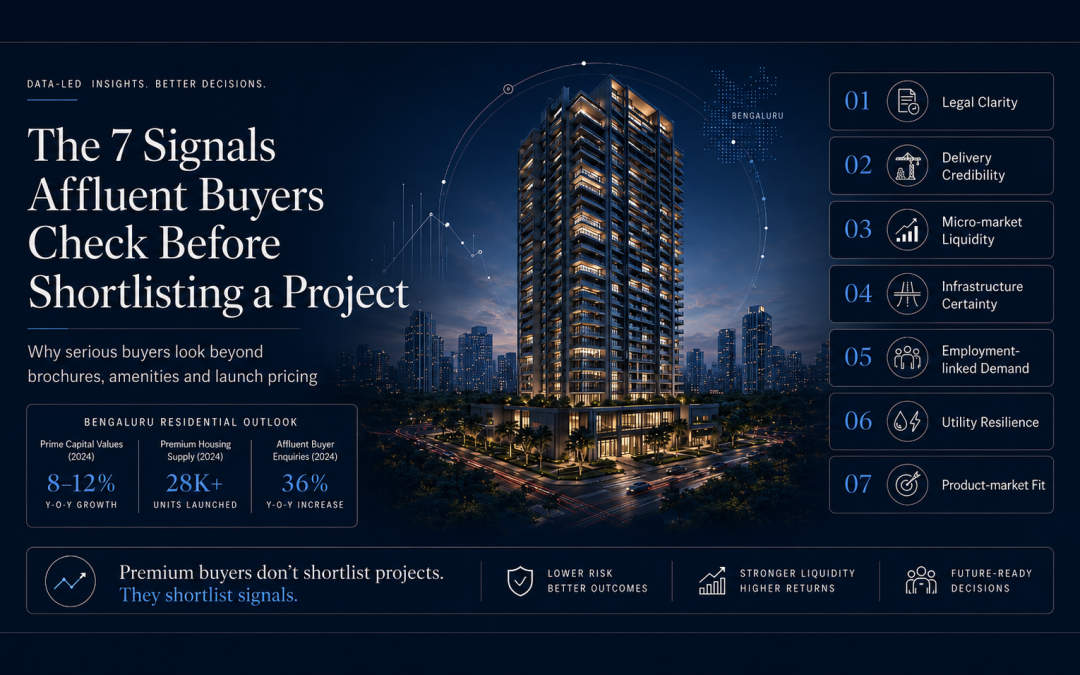
Why serious buyers look beyond brochures, amenities and launch pricing
There is one mistake many premium homebuyers make.
They assume a project is worth shortlisting because it looks premium.
A strong brochure.
A large clubhouse.
A luxury lobby.
A known developer name.
A launch-stage price.
It feels convincing.
But affluent buyers do not shortlist projects only on surface-level appeal.
They look for signals.
Because in premium real estate, the cost of a wrong decision is much higher.
A delay is not just a delay. It is rent, EMI, opportunity cost and uncertainty.
A weak micro-market is not just a location issue. It can affect resale depth, rental demand and future liquidity.
A poor utility plan is not just a facility issue. In Bengaluru, it can become a daily-life problem.
That is why serious buyers, founders, CXOs, HNIs and NRIs increasingly evaluate projects like an investment committee would evaluate a capital allocation decision.
They do not ask only:
“Is this project premium?”
They ask:
“Does this project clear the right signals?”
Because a project that fails two or more of these signals should usually be a watchlist asset, not a shortlist asset.
Why this matters now
India’s premium housing market is no longer a small niche.
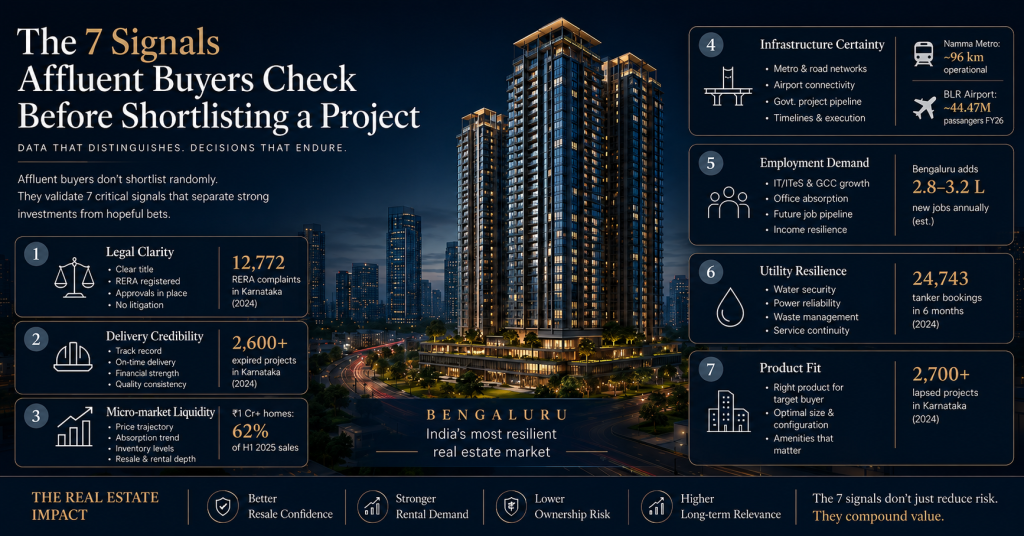
Homes priced above ₹1 crore accounted for 62% of residential sales in H1 2025, compared with 51% a year earlier.
That means more buyers are moving into higher ticket-size homes.
But the market is also becoming more uneven.
In Karnataka, more than 2,600 real estate projects had expired registrations and more than 2,700 were classified as lapsed by mid-2025. The state had also logged 12,772 RERA complaints by March 2026.
This is the contradiction affluent buyers need to understand.
Demand is strong.
But not every project deserves to be shortlisted.
The right buyer process is not about seeing more projects.
It is about filtering harder.
| Market Signal | What It Shows | Real Estate Impact |
| ₹1 Cr+ homes formed 62% of H1 2025 sales | Premium demand is widening | More buyers are entering higher-ticket homes |
| 2,600+ expired projects in Karnataka | Delivery risk is real | Legal and execution filters matter more |
| 2,700+ lapsed projects | Weak projects still exist in active markets | Brand recall is not enough |
| 12,772 RERA complaints | Buyer disputes remain high | Documentation must be verified |
| Bengaluru Metro ~96 km operational | Connectivity is improving | Better commute corridors can improve demand |
| BLR Airport ~44.47M passengers FY26 | North Bengaluru remains economically relevant | Airport-led markets need sharper evaluation |
| 24,743 tanker bookings in 6 months | Utility stress is real | Water resilience is now a buying signal |
The lesson is simple.
Affluent buyers should not shortlist projects because they look premium.
They should shortlist projects because they are structurally strong.
Signal 1: Legal and regulatory clarity
The first signal is simple.
No legal clarity, no shortlist.
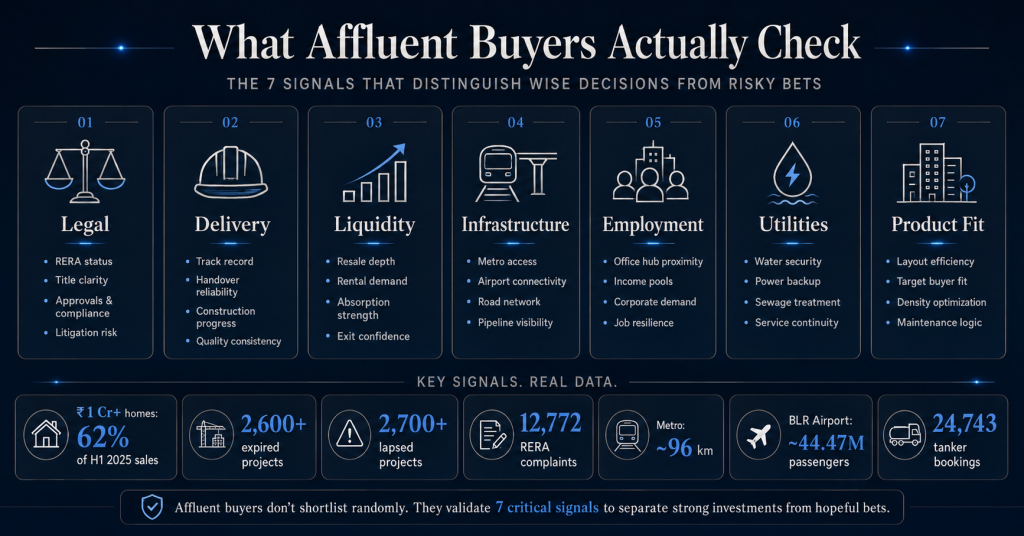
The project must be clean on RERA registration, title, approvals, sanctioned plan, quarterly updates and handover path.
Affluent buyers should check whether the RERA registration is active, whether project updates are being filed, and whether the sanctioned plan matches what is being sold.
A strong location cannot compensate for weak documentation.
In Bengaluru, buyers often confuse a good micro-market with a good project.
That is a mistake.
Even in active markets, weak projects exist.
Real estate impact
Legal clarity improves resale confidence, bankability and ownership security.
A legally clean project is easier to finance, easier to resell and easier to hold without uncertainty.
A project with expired registration, missing approvals or unclear phase-level documentation should not enter the shortlist.
Signal 2: Delivery credibility
The second signal is delivery.
A developer’s reputation is useful.
But delivery history is more useful.
Premium buyers should ask:
How many projects has the developer completed?
How delayed were the last five handovers?
Were earlier phases delivered as promised?
Is the balance sheet strong enough to finish construction?
In premium housing, delay is expensive.
The buyer may be paying rent, blocking capital, managing family timelines or planning relocation from another country.
That is why delivery credibility matters more than marketing scale.
Real estate impact
Delivery credibility protects capital.
A delayed project can reduce flexibility, increase carrying cost and weaken buyer confidence.
A strong developer is not just one who sells well.
A strong developer is one who repeatedly delivers with limited delay.
Signal 3: Micro-market liquidity
The third signal is liquidity.
A good property is not just one you can buy.
It is one you can exit without a deep discount.
City-level demand does not guarantee project-level liquidity.
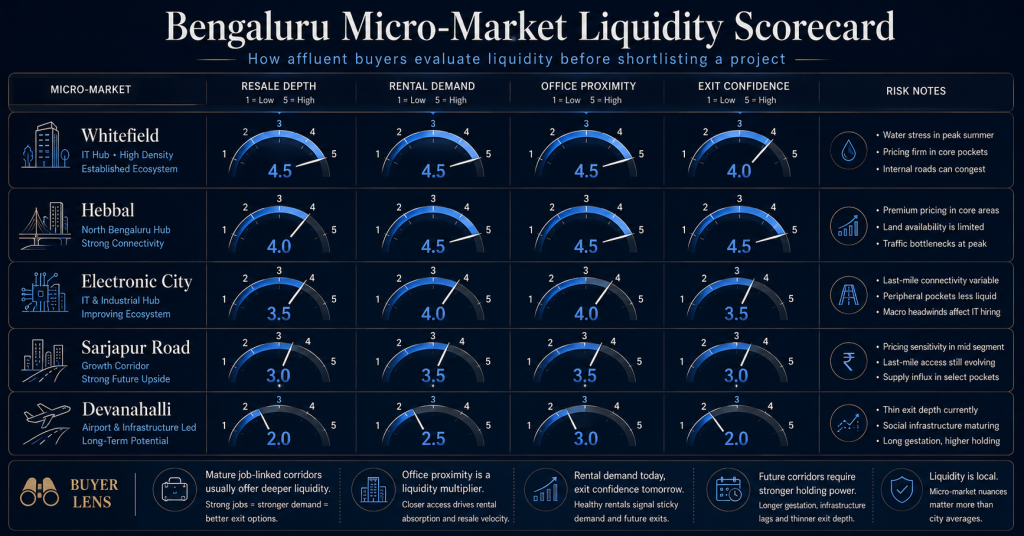
Bengaluru may be a strong housing market, but some corridors have deeper resale and rental demand than others.
Whitefield, Hebbal and ORR-linked locations usually have stronger liquidity because demand comes from multiple buyer pools: end-users, tenants, investors and corporate professionals.
Peripheral markets may offer future upside, but exit depth can be thinner.
Real estate impact
Liquidity directly affects resale value.
A project in a liquid micro-market gives the buyer stronger exit options, better rental depth and more pricing confidence.
A project sold mostly on “future growth” with little resale or rental evidence should be treated carefully.
Signal 4: Infrastructure certainty
The fourth signal is infrastructure certainty.
Buyers should separate operational infrastructure from proposed infrastructure.
This difference is critical.
An operational metro station is not the same as a proposed metro line.
A road under construction is not the same as a future corridor on a map.
Bengaluru’s infrastructure story is real. The metro network is now around 96 km operational, and selected Yellow and Pink Line catchments may see stronger residential demand.
But the value transfer is strongest where access is direct and usable.
| Infrastructure Situation | Likely Effect | Buyer Action |
| Under 1 km from operational station | Strong commute and rental advantage | Prioritise |
| Under 1 km from advanced under-construction station | Good upside, timing risk remains | Shortlist selectively |
| 1–3 km with strong last-mile | Moderate benefit | Price-sensitive buy |
| Proposal-only corridor | Weak immediate value transfer | Avoid paying full future premium |
Real estate impact
Infrastructure can improve commute confidence, rental demand and future buyer interest.
But only if it is real, usable and connected to employment or lifestyle demand.
“Near metro” should not be accepted as a sales line.
It should be verified as a real access advantage.
Signal 5: Employment-linked demand
The fifth signal is employment.
The best premium homes are usually linked to strong income pools.
Bengaluru remains one of India’s strongest office and tech markets. Whitefield, ORR and Hebbal continue to benefit because jobs already exist there.
This is why employment-linked locations usually show better rental resilience.
Hebbal benefits from Manyata and airport access.
Whitefield benefits from IT, GCC and R&D demand.
ORR benefits from large office ecosystems.
A project without employment-linked demand may still look good, but liquidity can become weaker when the market slows.
Real estate impact
Employment-linked demand improves rental depth and long-term absorption.
A premium home near strong job hubs usually has a wider buyer and tenant base.
Premium pricing without employment depth is a risk.
Signal 6: Utility resilience
The sixth signal is utility resilience.
This is especially important in Bengaluru.
Water, power backup, sewage handling and monsoon resilience are not backend technical points.
They are buying signals.
Bengaluru recorded 24,743 BWSSB tanker bookings in six months in 2025, with the East zone alone accounting for 13,023 bookings.
That tells us something important.
A premium address is not enough if daily operations are weak.
Buyers should check:
Water source mix.
Cauvery connection status.
STP and reuse capacity.
Underground and overhead storage.
Power backup specification.
Stormwater management.
In some corridors, the difference between a premium project and a painful project is not the lobby.
It is the engineering.
Real estate impact
Utility resilience protects daily livability and long-term project reputation.
If residents face recurring water, sewage or power issues, the project’s premium positioning weakens over time.
A vague answer on water and sewage should be treated as a serious red flag.
Signal 7: Product-market fit
The final signal is product-market fit.
A home must match how affluent households actually live.
The question is not only:
“How big is the apartment?”
The better question is:
“Is the space usable?”
Bengaluru buyers are increasingly moving toward larger 3BHK formats, better green space, work-from-home flexibility, community quality and sensible maintenance economics.
A project can have many amenities and still fail the daily-life test.
Buyers should check:
Unit efficiency.
Lift-to-unit ratio.
Parking ratio.
Density.
Open space.
Maintenance per sq ft.
Privacy.
Storage.
Work-from-home usability.
Guest flexibility.
Real estate impact
Product-market fit decides whether the home stays relevant 5–10 years later.
A project with practical layouts, controlled density and sensible maintenance economics usually has stronger end-user demand.
A project with showpiece amenities but poor daily usability may struggle to hold premium value over time.
Quick buyer checklist
| Signal | Minimum Acceptable Standard | Immediate Red Flag | Real Estate Impact |
| Legal clarity | Active RERA, approvals and current filings | Expired/lapsed status | Better resale confidence |
| Delivery credibility | Repeat handover record | Multiple delayed phases | Lower capital lock-in risk |
| Liquidity | Resale and rental evidence | Thin exit market | Stronger exit options |
| Infrastructure | Operational or visibly advanced access | Proposal-only story | Better demand visibility |
| Employment depth | Access to major job hubs | No rental demand base | Stronger tenant pool |
| Utility resilience | Clear water, sewage and backup plan | Tanker-only dependence | Better livability |
| Product fit | Efficient layout and sensible maintenance | Weak usability | Higher long-term relevance |
Real estate impact: why the seven signals matter
These seven signals are not just checklist points.
They directly affect the real estate value of a project.
A project with clean legal status is easier to finance, easier to resell and easier to hold with confidence.
A project from a credible developer reduces delivery risk and protects the buyer from capital being stuck for years.
A liquid micro-market gives the buyer stronger exit options if they want to sell later.
Operational infrastructure improves commute confidence, rental demand and long-term buyer interest.
Employment-linked locations usually create stronger rental depth because demand is backed by income, not speculation.
Utility resilience protects daily livability, especially in a city like Bengaluru where water, sewage and power backup can materially affect the ownership experience.
Product-market fit determines whether the home will stay relevant 5–10 years later.
A luxury project may look premium at launch.
But its real estate value is tested over time.
The projects that hold value better are usually the ones that clear these seven signals without depending only on marketing, scarcity claims or launch-stage excitement.

Final Thought
Affluent buyers rarely lose because they asked too many questions.
They lose because they asked the wrong ones.
A premium project is not defined only by marble, clubhouse size or brochure language.
It is defined by what survives deeper scrutiny.
Legal clarity.
Delivery credibility.
Micro-market liquidity.
Infrastructure certainty.
Employment-linked demand.
Utility resilience.
Product-market fit.
These are the seven signals that separate a project worth shortlisting from a project worth watching from a distance.
The real shortlist question is not:
“Which project looks premium?”
It is:
“Which project clears the seven signals without excuses?”
Because in premium real estate, the best decision is not always the most attractive project.
It is the project with the strongest underlying signals.
That is where better real estate decisions begin