

Why smart buyers use data to buy better property, not avoid property
Real estate continues to remain one of the strongest wealth-building assets for Indian families, founders, CXOs, NRIs and long-term investors.
A well-selected apartment in the right project, right micro-market and right entry price can create both lifestyle value and long-term capital appreciation.
But the keyword is: well-selected.
In today’s market, buyers often hear strong appreciation claims.
“Prices are up 40%.”
“This project has delivered 11% CAGR.”
“Launch buyers have already made ₹2,000 per sq ft.”
These statements may sound attractive.
And sometimes, the opportunity may genuinely be strong.
But serious buyers should not rely only on headline appreciation numbers.
They should understand how those numbers were calculated.
Because the best real estate decisions are not made by avoiding property.
They are made by buying the right property with better clarity.
A strong appreciation claim should motivate a buyer to investigate further, not blindly commit.
That is the difference between emotional buying and informed wealth creation.
The real question is not:
“Should I buy property?”
The better question is:
“Is this the right property, at the right price, with appreciation that can be verified?”
That is where better real estate decisions begin.
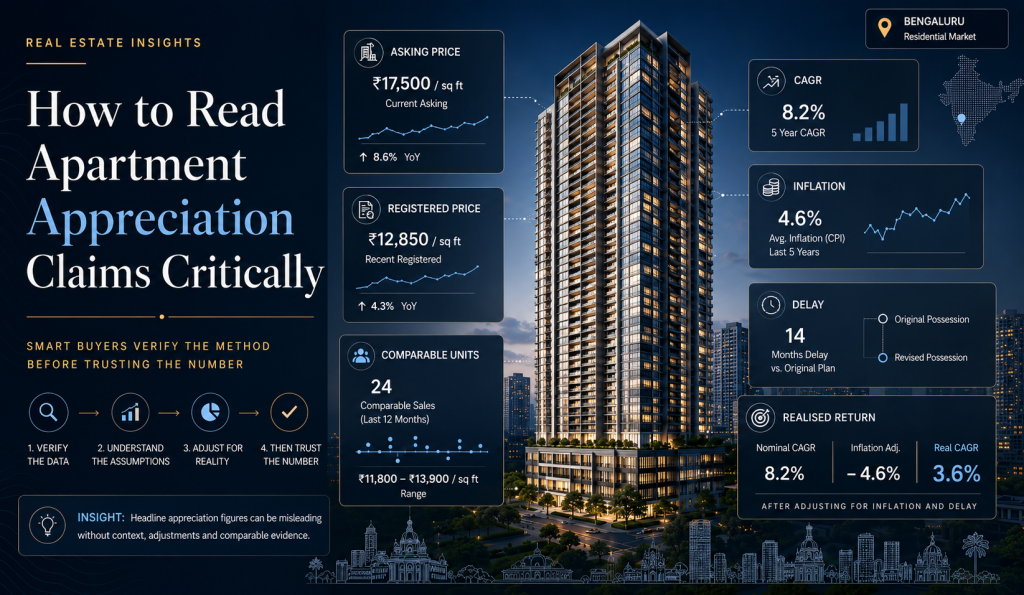
Appreciation is real. But the method matters.
Apartment appreciation can mean many different things.
A developer may say prices have increased because the quoted rate has moved up.
A broker may say a project has appreciated because similar units are listed higher online.
A seller may compare today’s expected resale price with an old launch price.
A consultant may refer to a broad market index.
All of these can be useful.
But they do not mean the same thing.
| Claim Style | What It Usually Means | What Buyers Should Ask |
| “Up 40%” | Simple difference between base and current price | What dates, unit and price basis? |
| “11% CAGR” | Annualised return over a period | Is it gross or net of costs and delays? |
| “Real appreciation” | Return adjusted for inflation | Which inflation figure was used? |
| “₹X per sq ft growth” | Increase in quoted rate | Carpet, built-up or super built-up area? |
| “Launch to current” | Launch quote vs current quote | Was there an actual resale transaction? |
| “Up to 15% annually” | Best-case outcome | How many units actually achieved this? |
The first rule is simple.
Do not reject appreciation claims.
Decode them.
A strong claim backed by real transaction evidence can be a very good buying signal.
A weak claim backed only by quotes should be treated as a starting point for deeper checks.
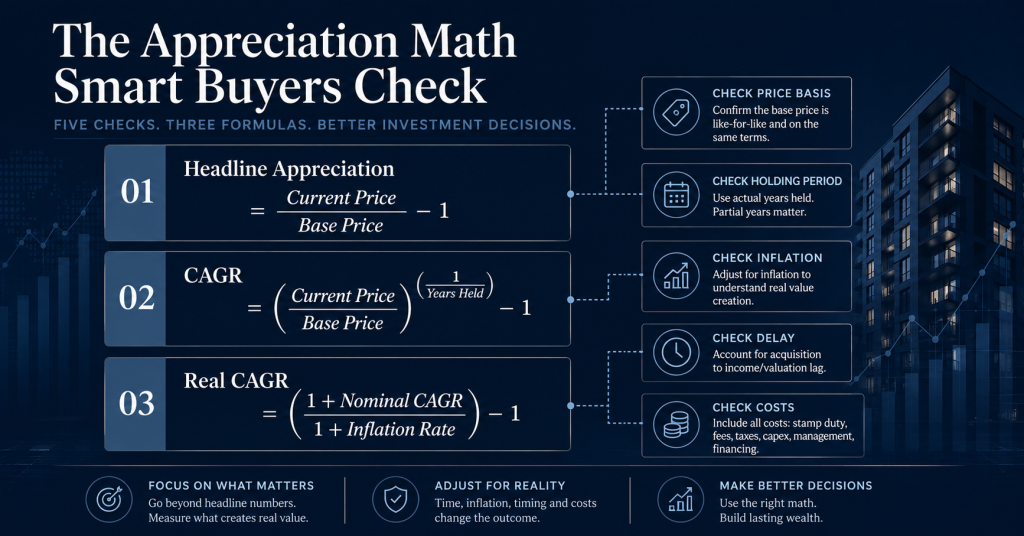
The three calculations every buyer should know
A serious appreciation claim should survive basic math.
1. Headline appreciation
Headline appreciation = Current price / Base price – 1
This tells you the simple increase in price.
But it does not tell you whether the return was good for the time taken.
2. CAGR
CAGR = Current price / Base price ^ 1 / years held – 1
This gives the annualised return.
But even CAGR can mislead if the holding period ignores delay.
3. Real CAGR
Real CAGR = 1 + nominal CAGR / 1 + inflation rate – 1
This shows whether the asset grew meaningfully after inflation.
For NRI buyers, there is one more layer: currency.
A rupee-denominated gain may look strong locally, but the actual return may differ when viewed in dollars, pounds or dirhams.
This does not reduce the appeal of Indian real estate.
It simply means the return should be read correctly.
Asking price is not the same as realised appreciation
One of the most common mistakes buyers make is treating asking prices as transaction evidence.
A listed price is not a closed price.
A developer quote is not a resale transaction.
A portal listing is not proof that buyers are paying that number.
Asking prices are useful.
They show market sentiment.
They show what sellers expect.
They show the current quoting range.
But they are not proof of realised appreciation.
| Data Source | What It Shows | How To Use It |
| Asking prices | Seller expectation | Good for sentiment |
| Developer quote | Current sales positioning | Good for primary-market trend |
| Broker comp | Market colour | Useful but should be verified |
| Registered deed | Actual transaction evidence | Stronger proof of appreciation |
| RERA record | Legal and project status | Good for delivery and compliance checks |
| Bank valuation | Financed-market view | Useful secondary support |
| Price index | Broad market trend | Good benchmark, not unit valuation |
For a serious buyer, the best evidence is not only a brochure rate.
It is a registered transaction or a tightly matched comparable set.
The better question is:
“Can this appreciation claim be backed by actual transaction evidence?”
If yes, the buyer has a stronger reason to move forward.
If no, the buyer should continue due diligence before committing.
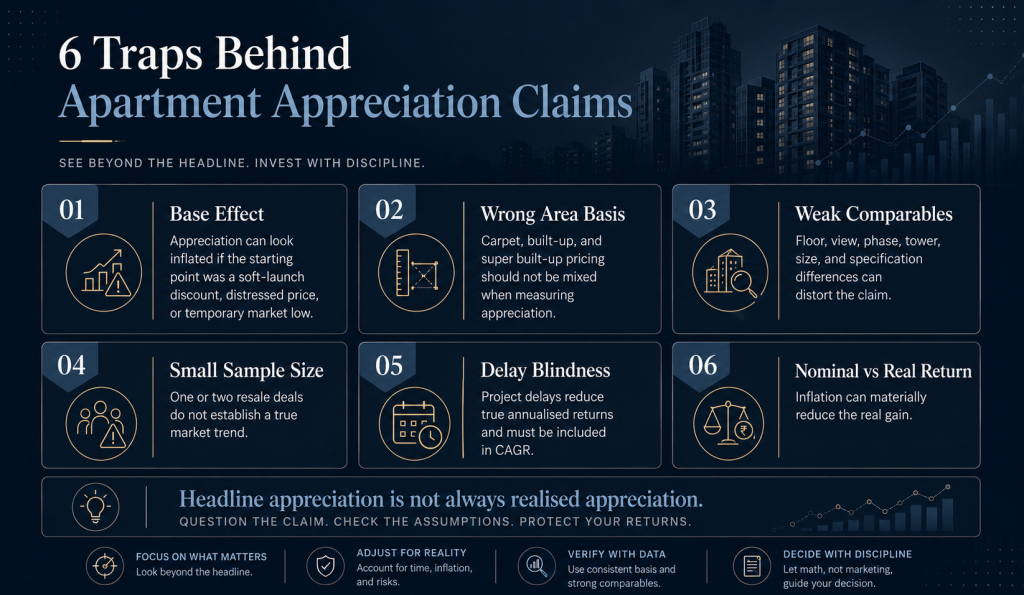
The common traps behind appreciation claims
1. Base effect
If the starting point is a soft-launch discount, pandemic trough or temporary distress price, the appreciation can look stronger than it actually is.
A project may claim strong growth from launch, but if the launch price excluded floor rise, parking, club charges or taxes, the comparison may be incomplete.
2. Wrong area basis
Apartment pricing can be quoted on carpet area, built-up area, saleable area or super built-up area.
If the base price uses one area basis and the current price uses another, the appreciation percentage becomes unreliable.
3. Weak comparables
A higher-floor unit with a better view cannot be blindly compared with a lower-floor unit in another tower.
Tower, phase, floor, view, size, specification and delivery status all matter.
4. Small sample size
If only two or three units have resold, one high-value deal can distort the appreciation story.
That is not a stable trend.
It is an anecdote.
5. Delay blindness
If a project was planned for three-year delivery but possession took five years, the CAGR must be calculated over five years, not three.
Delay reduces the annualised return.
It can also add rent, EMI, opportunity cost and uncertainty.
6. Nominal vs real confusion
A property may appreciate in nominal terms, but the real gain after inflation may be lower.
This does not mean the investment is weak.
It means the buyer should understand the true return.
Bengaluru buyers can build a stronger verification trail
For Bengaluru buyers, appreciation claims can be verified more seriously than most people realise.
A buyer can check property documents, transaction records, RERA details, completion status and comparable resale evidence before taking a call.
The process does not have to kill the excitement of buying.
It should build confidence.
| Verification Step | What To Check |
| Exact unit | Tower, phase, floor, facing, size and area basis |
| Base price | Was it registered value or launch quote? |
| Current price | Is it actual resale or only asking price? |
| Costs | Parking, taxes, brokerage, fit-out and finance cost |
| RERA | Registration, timelines, quarterly updates and extensions |
| Completion | OC, possession and handover status |
| Comparables | Same project, similar unit, similar floor band |
| Return | Nominal CAGR, real CAGR and net realised CAGR |
This is how buyers move from marketing appreciation to verified appreciation.
And verified appreciation is more powerful.
Because it gives the buyer confidence that the property is not just attractive on paper.
It has a stronger investment case.
Real estate impact: why this matters
Appreciation claims directly influence buying decisions.
If a buyer understands the claim correctly, they can enter better.
If they overestimate appreciation, they may overpay.
If they treat asking prices as resale evidence, they may misread liquidity.
If they ignore delay, they may overstate CAGR.
If they ignore legal or delivery status, they may confuse paper value with exit value.
This matters because premium apartments are not just lifestyle purchases.
They are large capital decisions.
A well-selected apartment can offer:
Better lifestyle value.
Potential rental income.
Long-term appreciation.
Emotional security.
Portfolio diversification.
Future resale value.
But these benefits are strongest when the buyer enters with clarity.
| Appreciation Type | Meaning | Buyer Interpretation |
| Quoted appreciation | Price has increased on paper | Useful, but needs verification |
| Market appreciation | Similar assets are trading higher | Stronger, if comparables are clean |
| Realised appreciation | Actual exit after costs and time | Strongest evidence |
| Net appreciation | Return after costs, delay and inflation | Best measure for serious buyers |
The goal is not to doubt every project.
The goal is to buy with more confidence.
The best buyers do not avoid real estate.
They use data to choose better real estate.

Quick buyer checklist
| Question | Why It Matters |
| Is the base price registered or quoted? | Launch quotes can understate entry cost |
| Is the current price transacted or listed? | Asking price is not execution proof |
| Are the units truly comparable? | Floor, view, size and tower can change value |
| Is the return gross or net? | Taxes, brokerage and finance costs reduce returns |
| Is CAGR based on actual holding period? | Delays reduce annualised returns |
| Is the claim inflation-adjusted? | Real return may be different |
| Is legal and delivery status clean? | Weak documentation affects resale |
| Is there actual liquidity? | Appreciation matters only if buyers exist |
This checklist should not make a buyer hesitant.
It should make the buyer sharper.
When a project clears these questions well, the decision becomes stronger.
Final Thought
Apartment appreciation is real.
Across strong cities like Bengaluru, the right projects in the right corridors have created meaningful long-term value for buyers.
But serious wealth creation does not come from chasing every appreciation claim.
It comes from understanding which claims are backed by real evidence.
A good apartment can offer lifestyle value, rental potential, long-term appreciation and emotional security.
But only when the buyer enters with the right checks.
So the goal is not to doubt every project.
The goal is to buy with more confidence.
Before trusting an appreciation claim, ask:
Was the base price real?
Is the current price transacted?
Are the units comparable?
Has delay been included?
Is the return net of major costs?
Is the project legally and physically ready for resale?
The best buyers do not avoid real estate.
They use data to choose better real estate.
Because in premium property, the strongest opportunity is not always the loudest claim.
It is the project where appreciation, legality, delivery, demand and liquidity all align.
That is when buying property becomes a smarter wealth decision.