
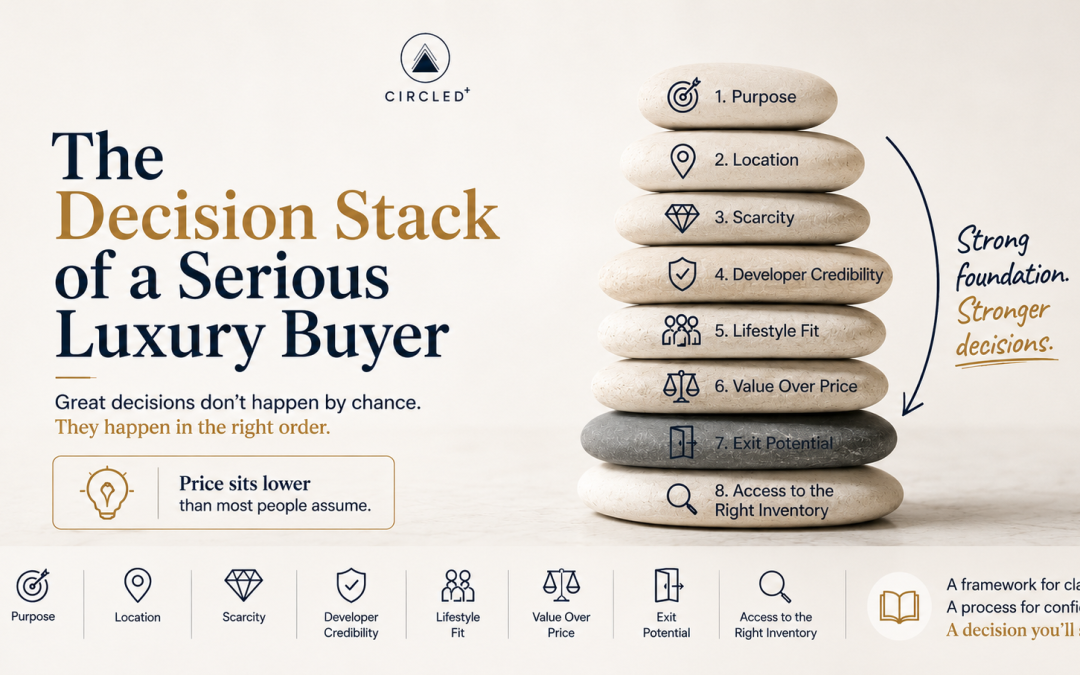
Buying a luxury home may look like one large decision, but it rarely works that way. Serious buyers do not simply walk into a property, like the view, compare the price, and make an offer. Their decision is built through a series of filters, where each layer answers a different question about the asset.
This is what we call the decision stack. It is the order in which an experienced buyer evaluates purpose, location, scarcity, lifestyle, value, and future relevance before committing to a home.
Purpose Comes Before Property
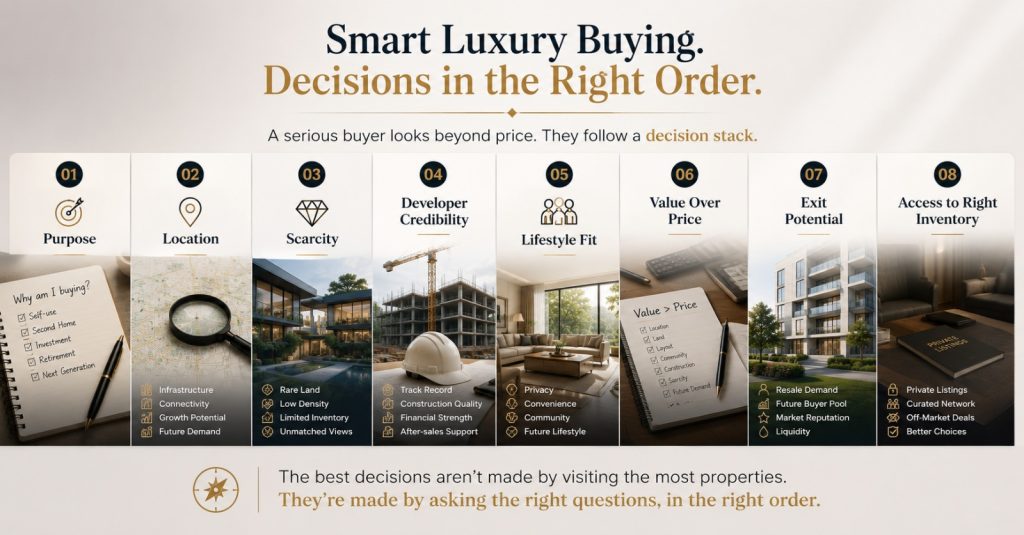
The process usually begins with clarity on why the property is being purchased. A home meant for self-use will be evaluated differently from a second home, an investment asset, a retirement residence, or a property intended to be passed on to the next generation.
This clarity prevents buyers from being distracted by homes that look impressive but do not support the larger objective. A property may offer strong appreciation potential but may not suit the family’s lifestyle. Another may be perfect for everyday living but may not be the strongest investment. The right property depends on the purpose behind the purchase.
Location Is Evaluated for the Future
Serious buyers do not look at a location only as it exists today. They study how the area may evolve over the next five to ten years through infrastructure, connectivity, business growth, social development, and future housing demand.
This matters particularly in Bengaluru, where two micro-markets with similar prices today can perform very differently over time. One may benefit from stronger connectivity and limited premium supply, while another may struggle with congestion, oversupply, or weak infrastructure. Location is therefore not just about convenience; it is about long-term relevance.
Scarcity Separates Luxury From Expense
Not every expensive property is a true luxury asset. The strongest luxury homes usually carry an element that is difficult to reproduce, such as a rare land parcel, low-density planning, limited inventory, distinctive architecture, large layouts, privacy, or uninterrupted views.
A home may appear premium because of its pricing and amenities, but if several similar options are easily available, its uniqueness may be limited. Serious buyers look beyond the visible features and consider whether the property will remain difficult to replace in the future.
The Project Must Build Confidence
The home is only one part of the purchase. Buyers are also placing confidence in the developer’s ability to deliver, maintain, and protect the quality of the project over time.
Delivery history, construction quality, financial credibility, maintenance standards, after-sales support, and long-term brand perception all influence this layer of the decision. A strong location can lose its advantage if the project is poorly executed, while a well-managed development can continue to command buyer confidence many years after completion.
Lifestyle Determines the Personal Fit
Once the broader fundamentals are clear, the decision becomes more personal. The buyer begins evaluating whether the home fits the family’s routines, privacy requirements, work patterns, social preferences, accessibility needs, and future lifestyle.
This is where many projects that look attractive on paper get rejected. The density may feel too high, the layout may not work for the family, or the location may make everyday travel inconvenient. Luxury is not defined by the number of amenities available. It is defined by how naturally the home supports the buyer’s way of living.
Price Is Viewed Through Value
Serious buyers care about price, but they rarely judge it in isolation. They compare the asking price with the quality of the location, land, layout, community, construction, scarcity, future demand, and available alternatives.
This is the difference between something being costly and something being overvalued. A lower-priced property may not be a better purchase if it is easily replaceable or weak on long-term demand. A higher-priced home may still offer stronger value if its location, quality, scarcity, and future relevance justify the premium.
The Exit Is Considered Early
Even buyers purchasing primarily for self-use should think about future liquidity. Families relocate, financial priorities change, and lifestyle requirements evolve. A home that feels permanent today may still need to be sold years later.
Experienced buyers therefore consider the future buyer pool, the reputation of the project, the strength of the micro-market, the relevance of the configuration, and the likely resale demand. The objective is not to make every purchase purely investment-led, but to avoid owning an asset that may become difficult to exit.
Access Influences the Quality of Choice
A buyer can only evaluate the opportunities they are able to discover. In luxury real estate, the complete market is not always visible on public property portals. Many homeowners prefer privacy, some properties are circulated only through trusted networks, and certain opportunities are sold before they reach the wider market.
This means that seeing more listings does not necessarily result in a better decision. What matters is access to the right inventory, along with enough context to compare the properties properly. A decision made from incomplete market visibility may overlook an option that is far better suited to the buyer.

Why the Order Matters
The decision stack works because each layer helps reduce noise. Purpose provides direction, location establishes future relevance, scarcity protects uniqueness, execution builds confidence, lifestyle creates personal fit, value supports the price, liquidity protects flexibility, and access improves the available choices.
Price is only one part of this process. Serious buyers do not start by asking which property is cheapest. They first establish whether the asset is right, and then decide whether the price being asked is justified.
Final Thoughts
The best luxury purchases are rarely made by buyers who visit the highest number of properties. They are made by buyers who evaluate the right properties in the right order.
At Circled Plus, our approach goes beyond presenting premium homes. We help buyers understand the context behind each opportunity, compare properties through a structured framework, and make decisions with greater clarity.
Because in luxury real estate, the quality of the decision matters far more than the quantity of options.