
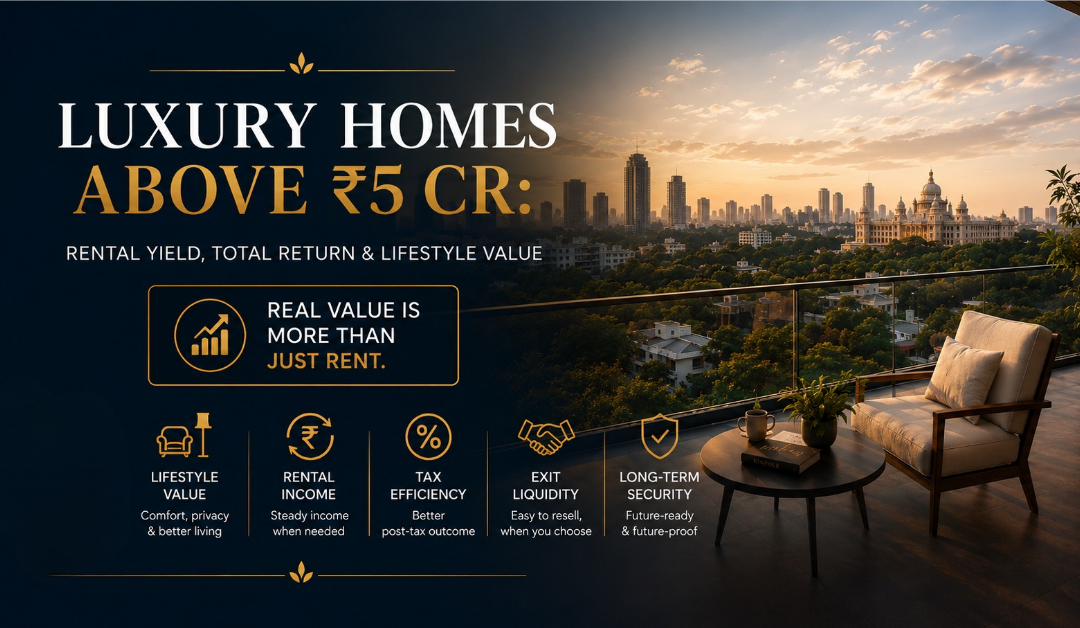
Luxury Homes Above ₹5 Cr: Look Beyond Rental Yield
Luxury homes above ₹5 Cr are rarely purchased for rental income alone.
At this price point, buyers ask broader questions:
- Will the property appreciate over time?
- Will it improve the family’s lifestyle?
- Can it become a future India base for an NRI?
- Does it offer privacy, convenience and long-term relevance?
The same property can mean different things to an investor, an owner-occupier, an NRI or a founder. That is why premium homes should be evaluated through a total-return lens, not just rental yield.
Rental Yield Is Only the Starting Point
Luxury homes generally provide lower rental yields because their purchase prices are significantly higher.
For example, a ₹10 Cr property earning ₹20 lakh annually provides a gross rental yield of approximately 2%.
That may appear low, but rental income is only one part of the return.
A luxury home should also be evaluated on:
- Capital appreciation
- Lifestyle value
- Holding costs
- Tax impact
- Rental demand
- Exit liquidity
- Long-term desirability
A property with modest rental income can still be a strong purchase if it is located in a scarce micro-market, has lasting buyer demand and appreciates consistently.
Similarly, a property offering attractive rent may still be risky if maintenance costs are high or resale demand is weak.
Luxury Home Return Snapshot
| Return Factor | What It Means | Why It Matters |
|---|---|---|
| Rental Yield | Annual rental income compared with the purchase price | Shows the basic income potential |
| Capital Appreciation | Increase in the property’s value over time | Usually the main wealth-creation driver |
| Lifestyle Value | Privacy, comfort, location, views and community | Often the main reason for purchasing |
| Holding Costs | Maintenance, taxes, brokerage and management expenses | Reduces the actual return |
| Exit Liquidity | Ability to resell the property easily | Important for investors and NRIs |
| Total Return | Rental income plus appreciation, minus costs and taxes | Gives the complete picture |
The better question is not:
“How much rent will I receive?”
It is:
“What will my total return be after costs, taxes and the holding period?”
What Creates Total Return?
Capital Appreciation
In most premium residential purchases, appreciation is the main wealth-creation driver.
Location, developer reputation, limited supply, connectivity and future demand determine whether the property will hold or increase its value.
Rental Income
Rental income can support ownership costs, but it should not be viewed in isolation.
Buyers must calculate the net rental yield after accounting for maintenance, property tax, brokerage, vacancy and property-management expenses.
Lifestyle Value
Luxury buyers also pay for factors that cannot be fully captured in a spreadsheet:
- Privacy
- Address
- Community
- Views
- Security
- Space
- Convenience
- Peace of mind
For an owner-occupier, these factors may be more important than rental yield.
Exit Liquidity
A premium property is valuable only if there is a future buyer for it.
Buyers should assess whether the home has broad resale appeal or whether it is too customised, overpriced or dependent on a very limited buyer pool.
Different Buyers Need Different Evaluation Frameworks
| Buyer Type | What to Prioritise |
|---|---|
| Investor | Entry price, appreciation, net rental yield and exit liquidity |
| Owner-Occupier | Family comfort, privacy, layout, commute and community |
| NRI Buyer | Legal clarity, documentation, remote management and future resale |
| Founder or CXO | Privacy, location, convenience, identity and long-term relevance |
Investor
A beautiful home is not automatically a good investment.
An investor should focus on asset performance, tenant demand, maintenance costs, future buyer demand and the ability to exit cleanly.
Owner-Occupier
An owner-occupier should focus on how the home supports daily life.
For someone planning to live in the property for 8–15 years, family comfort, privacy, layout and community can justify a lower rental yield.
NRI Buyer
For an NRI, the home may serve as a future India base, rental asset or long-term wealth-holding option.
Along with the property, the buyer must evaluate legal clarity, payment routes, documentation, property management, tax implications and future resale.
Founder or CXO
For founders and senior professionals, the decision may be driven by privacy, location, convenience and time saved.
The right home should support both personal lifestyle and long-term value.
Do Not Ignore the Complete Ownership Cost
The quoted property price is not the final cost.
Luxury buyers must also account for:
- Stamp duty and registration
- GST, where applicable
- Interior costs
- Maintenance deposits
- Monthly maintenance
- Property tax
- Brokerage
- Legal fees
- Rental income tax
- Capital gains tax
These expenses can materially change the final return.
The real return is calculated after costs—not from brochure numbers.
Match the Property to the Purpose
The biggest mistake luxury buyers make is trying to optimise everything at once.
They want the best lifestyle, highest rental yield, strongest appreciation, lowest price and easiest exit.
Every property involves trade-offs.
The first question should therefore be:
“What is the primary purpose of this purchase?”
For investment, prioritise performance and liquidity.
For self-use, prioritise livability and long-term family fit.
For NRI ownership, prioritise legal clarity, remote management and flexibility.
A clear objective creates a sharper shortlist and reduces the risk of overpaying for the wrong property.
Final Thought
Luxury homes above ₹5 Cr should not be judged only by the rent they generate.
Their real value comes from a combination of:
- Rental income
- Capital appreciation
- Lifestyle benefits
- Tax and holding costs
- Exit liquidity
- Long-term relevance
At this level, buyers are not simply purchasing square footage.
They are buying comfort, flexibility, capital preservation and future value.
The smartest question is not:
“What is the rental yield?”
It is:
“What is the real return—financially, personally and over the long term?”