

Why this belief is becoming risky in Bengaluru real estate
There is one belief many homebuyers carry into every property decision:
“If I wait, I will get a better deal.”
It sounds logical.
Prices feel high. Developers may discount later. Interest rates may soften. New projects may launch. A better opportunity may come.
But in a strong metro market like Bengaluru, waiting is not always a saving strategy.
Sometimes, waiting simply changes the price tag.
And in the worst cases, it also reduces the quality of the home available to the buyer.
The real question is not:
“Should I buy now or wait?”
The better question is:
“Is this specific home in a strong or weak market position?”
Because waiting works only when the asset is weak.
For scarce, well-located, credible, end-user-driven homes, waiting often becomes expensive.

Waiting is not free
Most buyers think of waiting as a neutral decision.
It is not.
Waiting has a cost.
There is the obvious cost: the price of the home may increase.
But there are also hidden costs.
Rent paid while waiting.
Better inventory getting sold.
Preferred floors disappearing.
View, layout, orientation, and privacy options reducing.
Future supply becoming more premium and more expensive.
So even if a buyer gets a small discount later, it may not actually be a better deal.
A discount on leftover inventory is not always better than early access to a stronger unit.
That is the part many buyers miss.
In Bengaluru, this matters even more because the market has changed sharply over the last decade.
Bengaluru 2016 vs 2026: the pricing game has changed
A useful way to understand this shift is to compare Bengaluru in 2016 with Bengaluru in 2026.
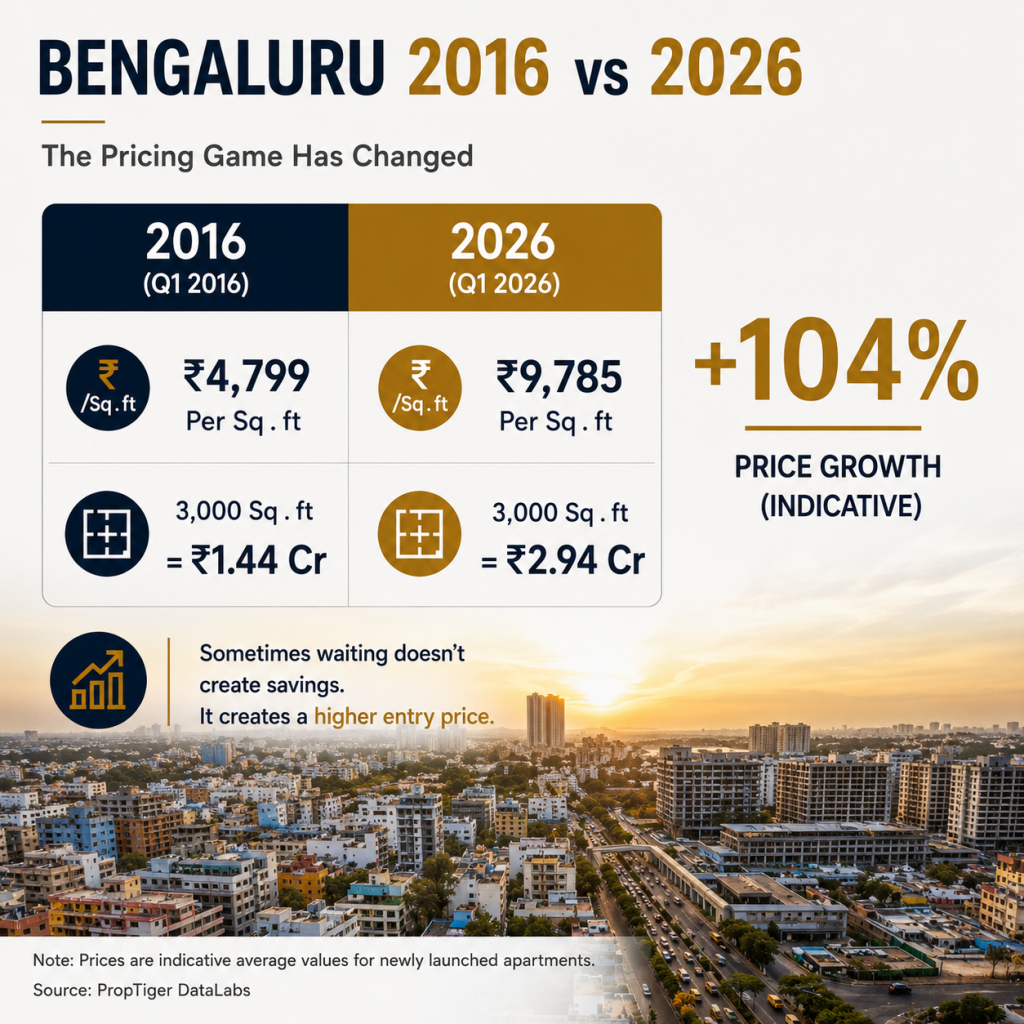
In H1 2016, average prices for newly launched apartments in Bengaluru were around ₹4,799 per sq ft.
By Q1 2026, Bengaluru’s reported average housing price stood at ₹9,785 per sq ft.
That is roughly a 104% increase on an indicative long-view comparison.
The difference becomes very real when we apply it to a large home.
A 3,000 sq ft home at ₹4,799 per sq ft would cost around ₹1.44 crore.
The same 3,000 sq ft home at ₹9,785 per sq ft would cost around ₹2.94 crore.
That is an indicative difference of about ₹1.5 crore before registration, interiors, floor premiums, parking, GST where applicable, and maintenance.
So the buyer who waited for the market to become cheaper may have actually waited into a much higher price environment.
This does not mean every buyer should rush.
But it does mean the old belief that “waiting always helps” does not fit the current Bengaluru market.
The post-Covid repricing cycle made waiting expensive
The 2016 comparison gives the long view.
But the post-Covid period tells the sharper story.
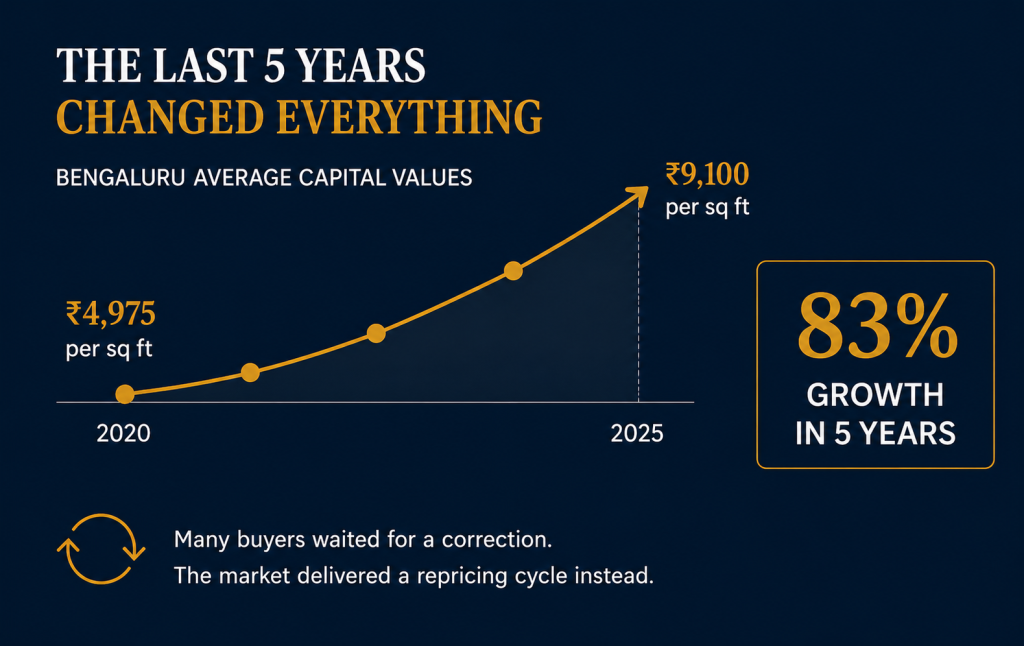
Bengaluru’s average capital values moved from around ₹4,975 per sq ft in 2020 to ₹9,100 per sq ft in 2025.
That is roughly 83% growth over five years.
The Q1 2026 reported average of ₹9,785 per sq ft suggests that the repricing cycle continued into 2026.
For many buyers, the last few years did not become a correction window.
They became one of Bengaluru’s strongest repricing cycles.
This is why waiting has become a risk in strong micro-markets.
A buyer waiting for a 5% discount may face a 10%, 15%, or 20% price movement before that discount ever appears.
And by then, the better unit may already be gone.
Supply is moving up the ticket curve
The risk is not only price.
The product mix itself is changing.
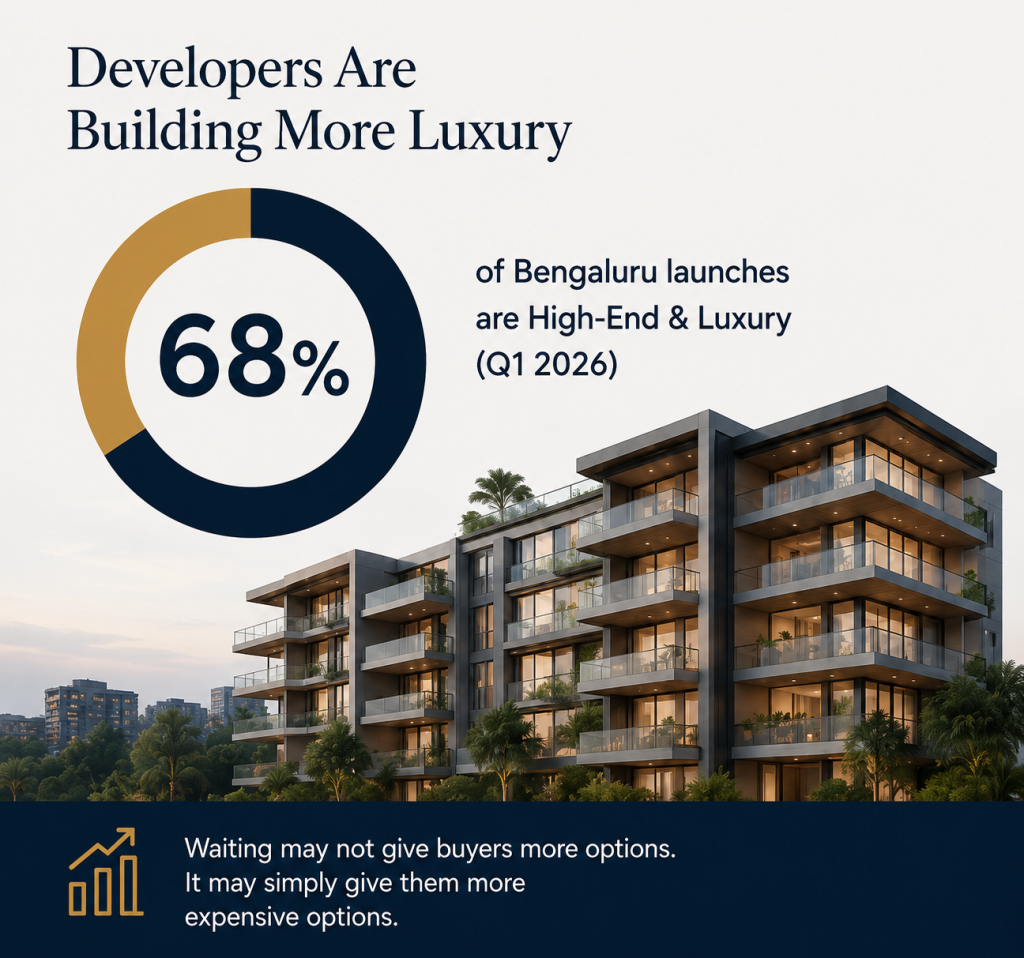
In Q1 2026, high-end and luxury launches formed 68% of Bengaluru’s residential launches.
That matters because a buyer waiting for “the same budget, better home” may instead find fewer homes available in their preferred budget bracket.
The market is moving up the ticket curve.
Developers are launching more premium homes because that is where demand, margins, and pricing power are stronger.
This is a very important shift.
Waiting may not give the buyer more options.
It may give the buyer more expensive options.
That is the danger of a premiumising market.
Bengaluru is not one market
The waiting decision cannot be made at a city level.
Bengaluru is not one housing market.
It is a cluster of micro-markets moving at different speeds.
In East Bengaluru, areas like Whitefield, ORR, Sarjapur Road, Bellandur, Varthur, and nearby corridors benefit from tech employment, GCCs, schools, gated communities, and commute-led demand. For credible projects with real end-user absorption, the waiting risk is high.
In North Bengaluru, Hebbal, Yelahanka, Jakkur, Devanahalli, and airport-linked corridors are driven by aviation, aerospace, business parks, villa communities, and long-term infrastructure expectations. Waiting may work in generic outer pockets, but it becomes risky in projects tied to real infrastructure and employment growth.
In Central Bengaluru, locations like Lavelle Road, Cunningham Road, Richmond Town, Ulsoor, Frazer Town, and similar pockets are scarcity-led address markets. Here, waiting rarely creates more land or comparable legacy inventory.
In South Bengaluru, Koramangala, JP Nagar, Jayanagar, HSR, Sarjapur Road, and surrounding pockets are supported by family demand, schools, social infrastructure, and established neighbourhood appeal. Waiting is selective. Generic oversupplied pockets may soften, but differentiated premium projects can hold pricing.
So the right question is not:
“Will Bengaluru prices fall?”
The right question is:
“Will this specific micro-market, project, and unit weaken enough to justify waiting?”
The rent trap: the hidden cost of waiting
One of the most ignored costs of waiting is rent.
A buyer who delays a purchase is not standing still financially.
They may be paying rent every month while the market keeps moving.
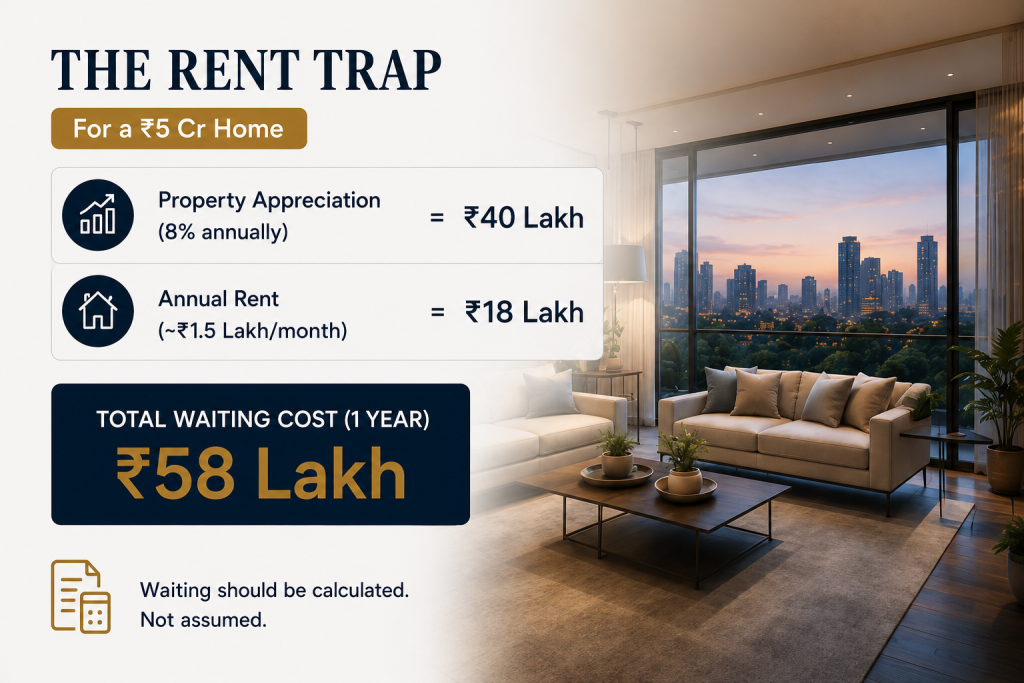
For example, assume a buyer is considering a ₹5 crore home.
If that home appreciates by 8% in one year, the price increase alone is ₹40 lakh.
If the buyer is paying ₹1.5 lakh rent per month, that adds another ₹18 lakh over 12 months.
That creates a visible waiting cost of ₹58 lakh in one year.
And this does not include registration changes, GST where applicable, maintenance, interiors, parking premiums, opportunity cost, or further price revisions.
This is why waiting needs to be calculated, not assumed.
A buyer waiting for a 5% discount can easily lose more than that through rent plus appreciation.
The interest-rate trap
Many buyers also wait because they expect home loan rates to fall.
But lower rates do not automatically create better deals.
If rates fall, more buyers may come back into the market.
That can support prices.
It can also reduce developer negotiation room in strong projects.
A lower interest rate on a higher purchase price may not be better than a slightly higher rate on an earlier, lower purchase price.
So the buyer should not look at interest rates in isolation.
They should compare total acquisition cost.
The question is not only:
“What will my EMI be?”
The question is:
“What will the total price, rent leakage, unit quality, and financing cost look like if I wait?”
That is the real buying math.
In luxury, waiting can reduce the home, not the price
For premium and luxury buyers, waiting often shows up in a different way.
It may not always show up as a higher price first.
It may show up as weaker inventory.
The best floor may be gone.
The better view may be gone.
The preferred layout may be gone.
The lower-density stack may be sold.
The best vastu option may no longer be available.
The unit with better privacy may not return.
The buyer may still find a home later.
But not the same home.
This is especially important in scarce central locations, boutique developments, luxury towers, and low-density communities.
In luxury real estate, waiting does not always reduce the price.
Sometimes, it reduces the home.
When waiting actually works
This does not mean waiting is always wrong.
Waiting can be a smart strategy when the asset is weak.
It can work when the project is in an oversupplied micro-market.
It can work when the developer is carrying high unsold inventory and needs cash flow.
It can work when approvals, RERA status, OC, legal clarity, or title confidence are weak.
It can work when construction timelines are uncertain.
It can work when the product is generic and easy to replace.
It can work when the seller is distressed or under time pressure.
It can work when a property is luxury-priced without true luxury in address, design, density, brand, or scarcity.
So the balanced view is simple:
Waiting is useful in weak inventory.
Waiting is costly in scarce, well-located, end-user-driven inventory.
A better buyer playbook
Instead of asking whether to buy now or wait, buyers should ask better questions.
Is the micro-market supply-constrained or oversupplied?
Is the developer credible and price-disciplined?
Is the specific unit replaceable?
Is rent leakage material?
Are there visible infrastructure triggers?
Is the buyer financially ready?
These questions matter more than market gossip.
A good buying decision is not about rushing.
It is about understanding whether time is working for you or against you.
If the home is generic, overpriced, weakly located, legally unclear, or poorly absorbed, waiting can create leverage.
But if the home is scarce, credible, well-located, and backed by real end-user demand, waiting may not improve the deal.
It may simply make the same decision more expensive later.
Final thought
The buyer myth is not completely wrong.
Waiting can get you a better deal.
But only in the right market, with the right asset, and the right seller pressure.
In strong Bengaluru micro-markets, waiting is not free.
It has rent costs.
It has price costs.
It has inventory-quality costs.
It has opportunity costs.
The best deal is not always the lowest price.
Sometimes, the best deal is the right home, in the right micro-market, before the market fully prices it in.
For serious buyers, the question should not be:
“Should I wait?”
It should be:
“Is this specific home likely to weaken, or am I waiting into a more expensive market?”
That is the new buying math in Bengaluru real estate.