
Why Bengaluru is no longer one housing market
Bengaluru real estate has changed.
For years, the city’s housing story was read as one broad market: more jobs, more migration, more homes, more demand. But that view is now too simple.
The city is no longer moving as one housing market.
Affordable demand is under pressure, while premium and luxury housing are being driven by a very different buyer base. The split is now visible in the numbers.
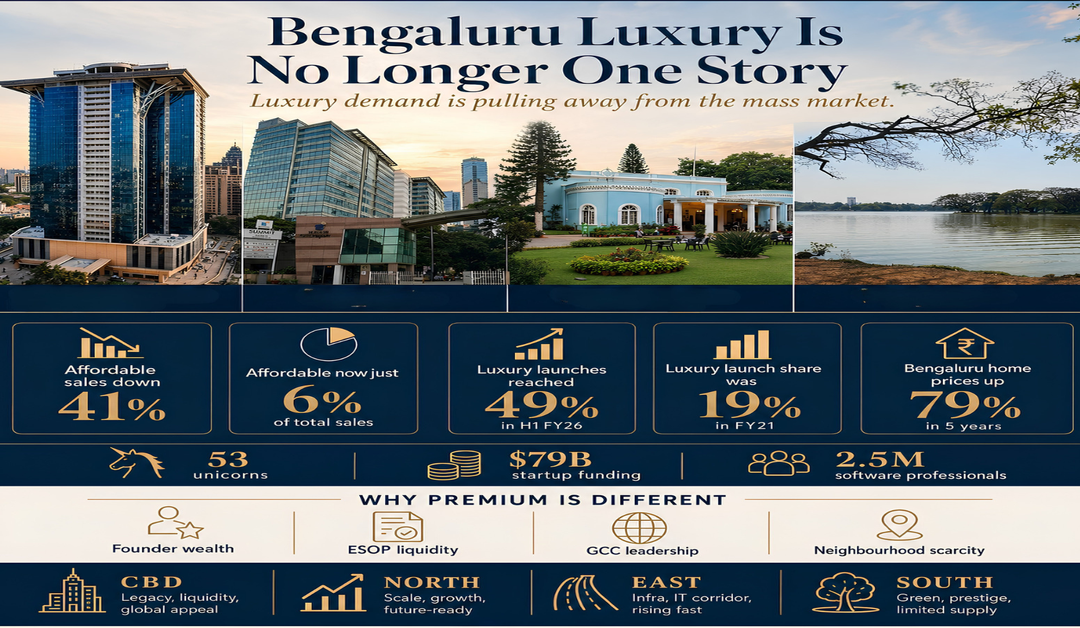
Citywide residential sales softened from 102 million sq ft in FY24 to 99 million sq ft in FY25. On the surface, that looks like a small correction. But inside the market, the story is much sharper.
Affordable housing sales fell 41%.
Affordable now forms just 6% of total sales.
Mid-income and luxury still grew 3%.
Luxury launches reached 49% of total launches in H1 FY26, up from 19% in FY21.
Bengaluru home prices have risen 79% over five years.
This is not just a price cycle.
It is a structural premiumisation of Bengaluru real estate.
The real split: EMI market vs wealth market
The simplest way to understand Bengaluru today is this:
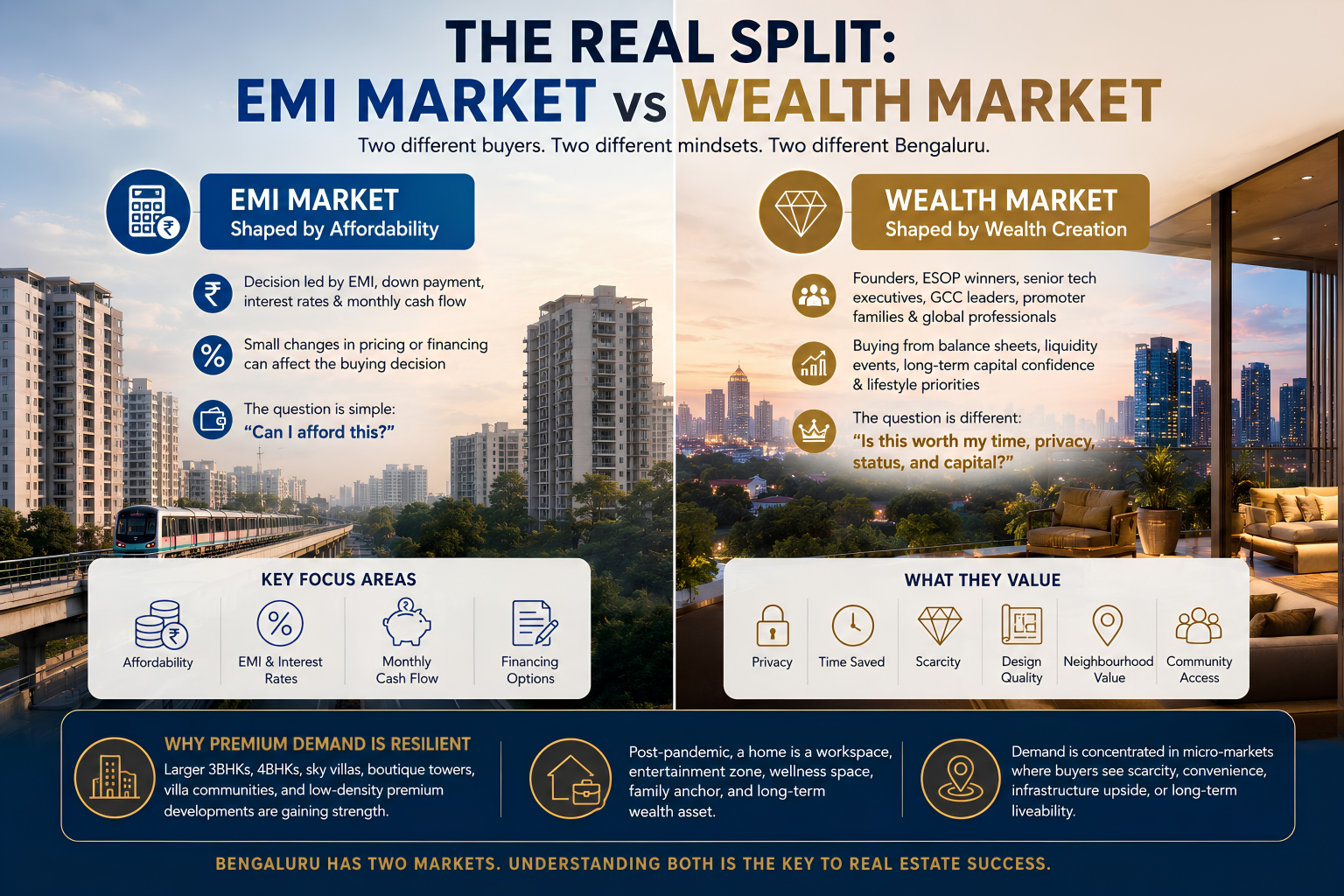
The mass market is being shaped by affordability.
The luxury market is being shaped by wealth creation.
For an affordable or mid-market buyer, the decision is usually led by EMI, down payment, interest rates, and monthly cash flow. Even a small change in pricing or financing can affect the buying decision.
But the premium buyer behaves differently.
Founders, ESOP winners, senior tech executives, GCC leaders, promoter families, and globally compensated professionals are not buying only through monthly salary logic. They are buying from balance sheets, liquidity events, long-term capital confidence, and lifestyle priorities.
That changes the entire psychology of the purchase.
The mass-market buyer asks: “Can I afford this?”
The luxury buyer asks: “Is this worth my time, privacy, status, and capital?”
That is a very different question.
And that is why luxury demand in Bengaluru is becoming more selective, more corridor-specific, and more relationship-driven.
Why premium demand is still resilient
At the top end, the buyer is not only buying square footage.
They are buying privacy.
They are buying time saved.
They are buying scarcity.
They are buying design quality.
They are buying neighbourhood value.
They are buying access to a certain kind of community.
This is why larger 3BHKs, 4BHKs, sky villas, boutique towers, villa communities, and low-density premium developments are gaining strength.
Post-pandemic, the meaning of a premium home has changed. A home is no longer just a place to live. For many affluent buyers, it is also a workspace, entertainment zone, wellness space, family anchor, and long-term wealth asset.
That is also why the city’s premium demand is not evenly distributed. It is concentrated in micro-markets where the buyer sees either scarcity, convenience, infrastructure upside, or long-term liveability.

Bengaluru luxury is no longer one story
The phrase “Bengaluru luxury real estate” sounds like one category.
It is not.
Different parts of the city are premium for very different reasons.
CBD and Central Bengaluru are driven by scarcity, legacy value, and irreplaceable addresses. Locations around Lavelle Road, UB City, Kingfisher Towers, Bangalore Club, Cunningham Road, and other central pockets carry a different kind of value. Here, the premium is not just about the building. It is about address, access, prestige, and the fact that comparable supply is limited.
North Bengaluru is driven by infrastructure and future value. The airport corridor, Hebbal, Yelahanka, Devanahalli, villa communities, plotted developments, and large-format living create a very different premium thesis. This is not only about centrality. It is about future access, scale, and long-term growth.
East Bengaluru is driven by tech wealth and productivity. Whitefield, ORR, Sarjapur Road, and surrounding corridors benefit from tech employment, GCC leadership, founder wealth, and upgrade demand. The buyer here is often looking for larger homes, gated communities, commute efficiency, and better lifestyle infrastructure.
South Bengaluru is driven by liveability and end-user strength. JP Nagar, Bannerghatta Road, Jayanagar-side catchments, and established southern pockets appeal to buyers who value schools, greenery, community, metro-led access, and a calmer residential environment.
So the real insight is simple:
Bengaluru luxury is not one market.
It is a set of micro-markets.
And each micro-market has its own buyer profile, price logic, and demand driver.

Developers are following pricing power
The launch mix says a lot about where developers see opportunity.
When luxury launches rise from 19% of total launches in FY21 to 49% in H1 FY26, it shows that developers are not merely reacting to demand. They are reallocating capital toward the segment where pricing power is stronger.
Luxury housing offers better margins, stronger ticket sizes, and buyers who can absorb price increases more comfortably than the mass market.
But this does not mean every luxury launch will work.
Premium buyers are resilient, but they are also selective. They will pay for the right address, right product, right builder, right design, and right neighbourhood story. They will not pay a premium just because a project uses the word “luxury.”
In Bengaluru’s next phase, the winners will not be generic premium projects.
The winners will be projects that are sharply positioned around a clear micro-market thesis.
What this means for buyers
For buyers, the main lesson is this: do not evaluate Bengaluru real estate only by citywide price growth.
The better question is: which micro-market is being repriced, and why?
A central Bengaluru boutique luxury apartment and a North Bengaluru villa community may both be premium assets, but they are not the same investment.
One may be a scarcity-led asset.
The other may be an infrastructure-led growth asset.
An East Bengaluru gated community may solve for productivity and tech access.
A South Bengaluru home may solve for liveability and long-term end-user depth.
The right purchase depends on the buyer’s lifestyle, time horizon, risk appetite, and reason for buying.
In premium real estate, fit matters more than availability.
What this means for luxury marketing
The marketing playbook also needs to change.
Premium homes cannot be marketed like mass housing.
Generic lead-generation campaigns, brochure-style creatives, discount-led messaging, and “book your dream home” communication do not match how high-intent luxury buyers think.
This buyer does not want more noise.
They want context.
They want discretion.
They want sharper curation.
They want to understand why a specific home, in a specific micro-market, is worth their time.
For this audience, content has to sound like market intelligence, not a sales pitch.
A strong premium real-estate brand should explain:
Why this micro-market matters.
Why this product is scarce.
Why this address has long-term value.
Why this builder is credible.
Why this opportunity is worth attention now.
That is the difference between selling inventory and building trust.
Final thought
Bengaluru luxury real estate is no longer just becoming more expensive.
It is becoming more selective.
The city’s top-end housing market is being shaped by wealth creation, corridor-specific demand, infrastructure upgrades, privacy needs, and long-term neighbourhood value.
The mass market is still important, but it is dealing with a very different reality: affordability pressure, financing sensitivity, and limited supply in the right price bands.
That is the structural break.
Bengaluru is no longer one housing market.
And in the premium segment, the winning question is no longer:
“What is available?”
It is:
“What is truly worth access?”
At Circled Plus, we believe luxury home discovery should be curated, not crowded.