
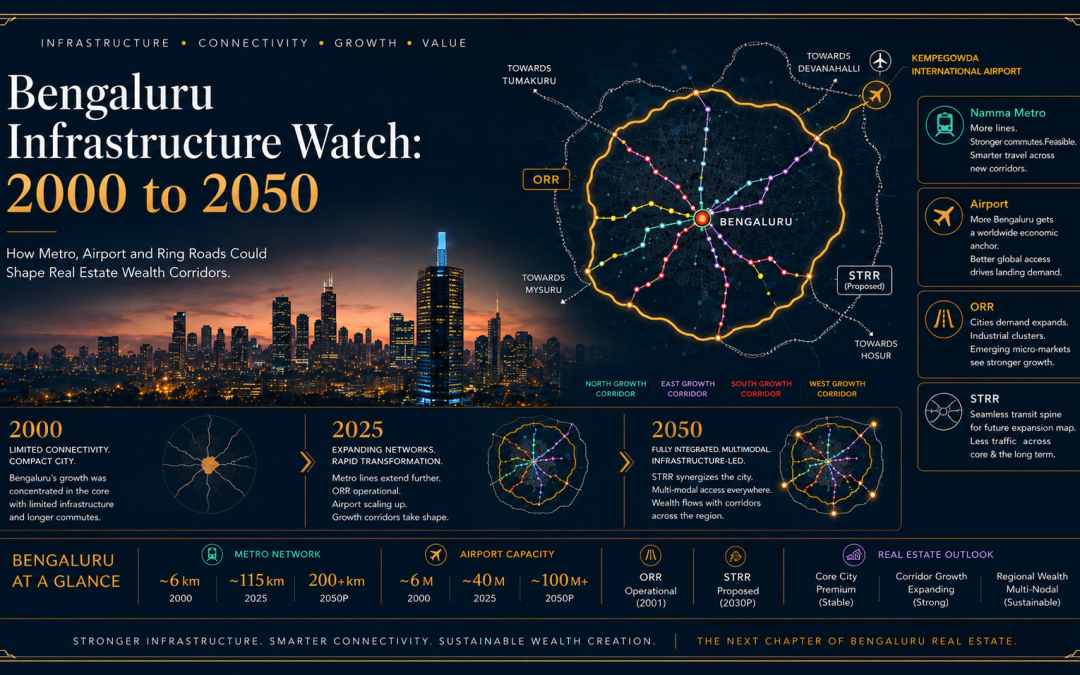
Why Metro, Airport, ORR and STRR Could Shape Bengaluru’s Next Real Estate Wealth Corridors
There is one mistake many property buyers make.
They assume real estate prices move only because of real estate.
Developers launch projects. Demand improves. Inventory reduces. Prices increase.
It sounds logical.
But Bengaluru’s biggest real estate shifts over the last 25 years tell a deeper story.
Infrastructure often moved first.
Property values followed later.
Whitefield did not become one of Bengaluru’s strongest office and residential markets only because developers built apartments there. Electronic City did not become a major housing market only because buyers wanted larger homes. Hebbal did not become a premium corridor only because luxury towers arrived.
Infrastructure changed the economics of these locations.
Connectivity improved. Employment grew. Commercial activity expanded. Residential demand followed.
That is why Bengaluru’s next real estate cycle may already be under construction — not inside a launch brochure, but inside metro corridors, airport expansion plans, ring roads, suburban rail and future connectivity projects.
For serious buyers, founders, CXOs, NRIs and investors looking at premium homes, this is not just an infrastructure story.
It is a real estate timing story.
The real question is not:
“Which project should I buy?”
The better question is:
“Which infrastructure corridor is Bengaluru quietly building its future around?”
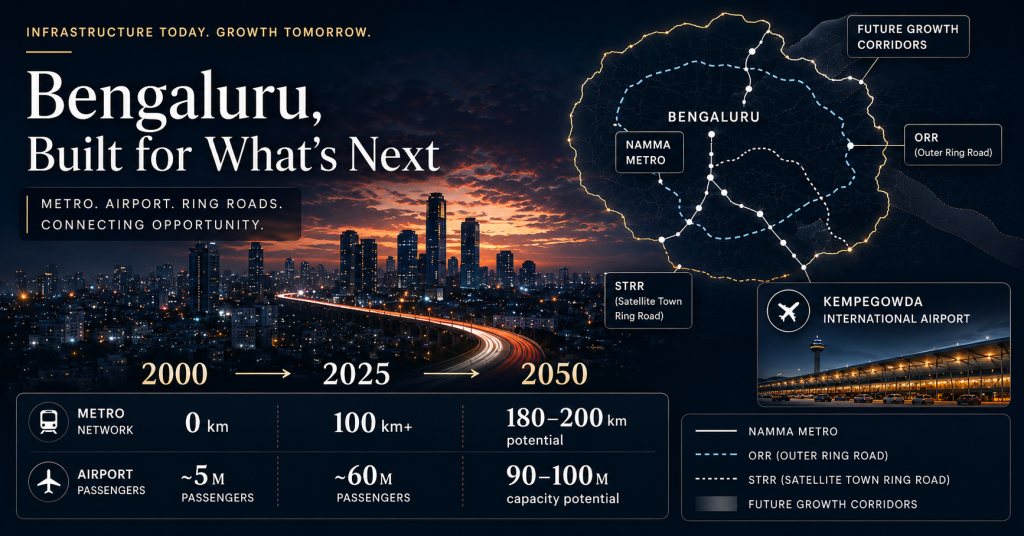
In 2000, Bengaluru was already India’s technology capital, but its infrastructure footprint was limited.
There was no operational metro. Kempegowda International Airport had not opened. STRR was not yet a real mobility layer. The city depended heavily on road-based commuting. Most premium housing decisions were shaped by legacy locations such as MG Road, Indiranagar, Koramangala, Jayanagar, Richmond Town, Cunningham Road and central Bengaluru.
By 2025, the city had changed into a multi-nodal urban economy.
Whitefield is no longer “far.” ORR is not just a road; it is a commercial engine. Hebbal is not just a junction; it is a premium North Bengaluru gateway. Devanahalli is no longer just an airport location; it is a long-term economic corridor.
The lesson is simple.
Bengaluru did not simply grow bigger.
It became more connected.
And connected cities create new property markets.
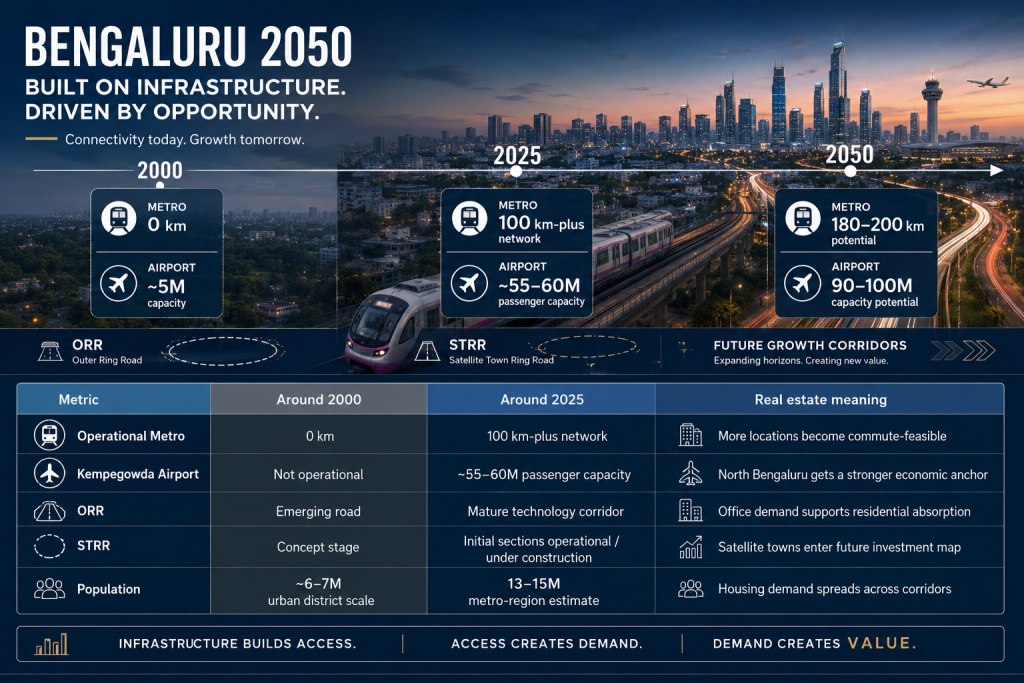
Infrastructure does not just reduce commute time. It changes demand.
Most people think infrastructure is about convenience.
It is.
But for real estate, infrastructure does something bigger.
It changes demand.
A metro line changes how people evaluate a location. An airport changes the commercial gravity of a region. A ring road changes which peripheral corridors become investable.
The chain usually works like this:
Infrastructure improves connectivity → connectivity reduces friction → reduced friction increases commercial and residential demand → demand attracts developers → good supply creates price confidence.
This is why infrastructure-led real estate is rarely instant, but when it works, the impact is deep.
Whitefield became a major market because it combined employment, office stock, road connectivity and later metro connectivity. Hebbal gained because airport access, Bellary Road, commercial expansion and premium housing supply changed buyer perception. Electronic City is again becoming more relevant because metro access improves commute confidence.
The best-performing locations are not just good places to live.
They are connected to where the city is going.
Metro: Bengaluru’s biggest urban transformation story
Namma Metro is one of Bengaluru’s most visible infrastructure-led real estate stories.
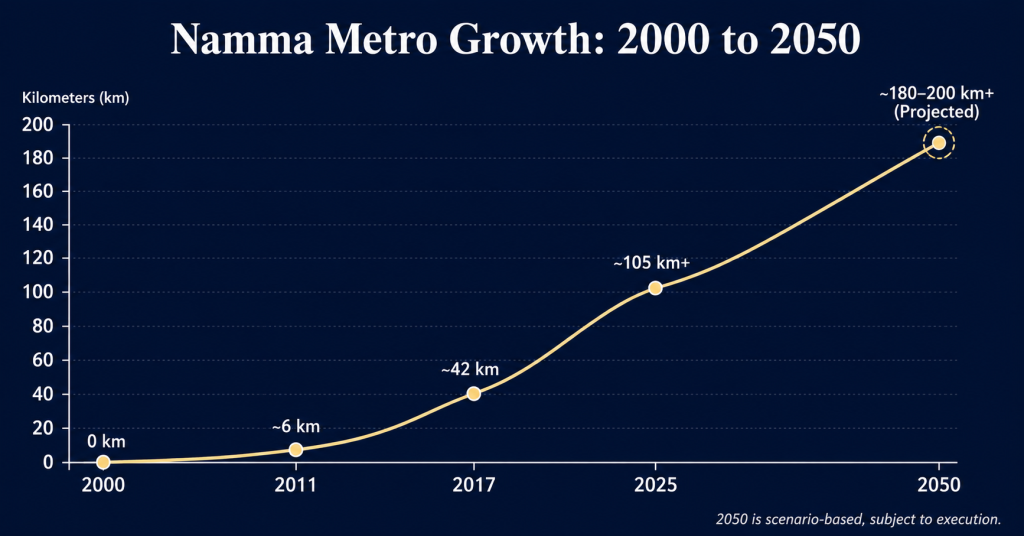
In 2000, the metro network was zero.
The first operational stretch opened in 2011. Phase 1, at around 42 km, became fully operational in 2017. By 2025, the network had expanded significantly through extensions and new corridors.
The long-term direction is clear.
Bengaluru is moving from a road-heavy city to a rail-supported city.
That matters because traffic friction has historically limited how far premium buyers were willing to move. A location may have good homes, but if daily movement is painful, the buyer pool becomes smaller.
Metro changes that equation.
It increases the number of people willing to consider a location. It improves rental depth. It supports commercial activity. It makes secondary and peripheral locations more acceptable for end-use buyers.
| Period | Metro status | Real estate implication |
| 2000 | 0 km | No metro-led premium |
| 2011 | First operational stretch | Central connectivity improves |
| 2017 | Phase 1 complete, ~42 km | Metro-linked locations gain credibility |
| 2025 | 100 km-plus network | More micro-markets become commute-feasible |
| 2050 potential | 180–200 km-plus | Bengaluru becomes more decentralised |
But the real estate impact is not equal everywhere.
A metro line through a weak market does not automatically make it premium. The impact is strongest when metro access combines with jobs, schools, retail, hospitals and credible housing supply.
So buyers should not ask only:
“Is there a metro?”
They should ask:
“Does the metro connect this location to real employment and lifestyle demand?”
Airport expansion: North Bengaluru’s long-term engine
If Metro changed how Bengaluru moves within the city, the airport changed how Bengaluru expanded north.
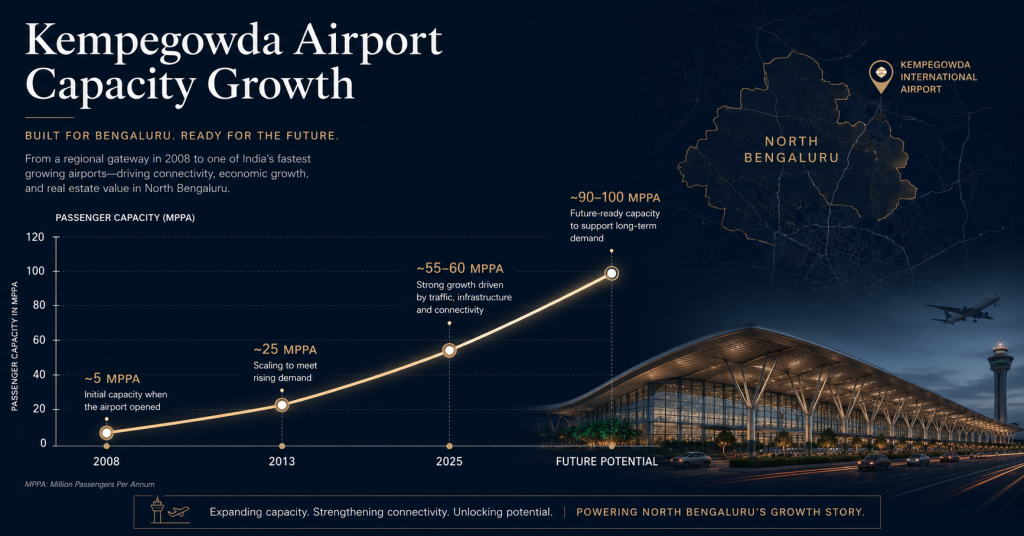
Kempegowda International Airport opened in 2008. At the time, many buyers considered the airport corridor too far from the established city.
Today, that view has changed.
The airport is no longer just a transport asset. It is an economic anchor.
| Period | Airport milestone | Real estate implication |
| 2008 | Airport opens | North Bengaluru enters investment map |
| 2013 | Capacity expands to around 25 MPPA | Hospitality and commercial demand improves |
| 2023 | Terminal 2 begins operations | Airport becomes stronger global gateway |
| 2025 | Around 55–60 MPPA capacity | North Bengaluru gains institutional relevance |
| Future | 90–100 MPPA potential | Airport corridor may become larger economic zone |
This is why Hebbal, Jakkur, Yelahanka, Devanahalli and the airport corridor cannot be evaluated only as residential markets.
They are part of an airport-led growth thesis.
Airports create multiple demand layers: business travel, logistics, hospitality, aerospace, commercial parks, senior executive housing, NRI interest and premium gated communities.
But North Bengaluru is not one market.
Hebbal has stronger city connectivity and premium apartment depth. Jakkur and Yelahanka offer lifestyle-led residential value. Devanahalli is more future-facing, linked to airport-led economic development and long-term infrastructure execution.
The better question is not:
“Will North Bengaluru grow?”
It is:
“Which part of North Bengaluru matches my time horizon and use case?”
ORR: the road that became an economy
The Outer Ring Road is not just a road.
It is a commercial spine.
ORR helped connect employment hubs and enabled the growth of office campuses, technology parks, rental markets and residential catchments across Bellandur, Marathahalli, Sarjapur Road, HSR Layout, Kadubeesanahalli and Whitefield-adjacent locations.
The ORR story proves that infrastructure and employment must be studied together.
A road without jobs may improve movement.
A road with jobs creates demand.
That is why ORR became powerful.
It connected employment with housing demand.
But mature corridors can become expensive, congested and heavily priced-in. So investors need to separate a “good location” from a “good entry point.”
STRR: Bengaluru’s next regional growth layer
If ORR helped create Bengaluru’s technology corridor, STRR could influence the next regional growth map.
The Satellite Town Ring Road is designed to connect towns around Bengaluru and reduce pressure on the city’s core network. It can improve access around belts such as Doddaballapur, Devanahalli, Hoskote, Kanakapura-side corridors, Ramanagara, Magadi and surrounding regions.
For real estate, this matters because ring roads can change the logic of land and housing markets.
They can support logistics, industrial movement, regional access and long-term development.
But STRR should be read carefully.
It is not a short-term luxury housing trigger everywhere.
It is a long-term regional connectivity trigger.
Buyers should ask:
Does the location have employment potential? Is there social infrastructure? Is access to Bengaluru practical? Is demand real or speculative? Is the land legally clean?
Ring roads can create wealth.
But they can also create hype.
The difference is execution, location quality and timing.
Infrastructure opportunity scorecard
| Micro-market | Infrastructure logic | Real estate interpretation |
| Hebbal | Airport + city access | Strong premium end-use and investment corridor |
| Devanahalli | Airport + STRR | Long-term airport-led growth play |
| Whitefield | Metro + office market | Mature employment-led residential market |
| Sarjapur Road | Future metro + family demand | Future connectivity-led growth corridor |
| Electronic City | Yellow Line + employment | Improving commute-led residential case |
| CBD / Central Bengaluru | Scarcity + legacy address | Premium scarcity play |
| Jakkur / Yelahanka | Airport access + lifestyle | North Bengaluru residential play |
| Hoskote belt | STRR + industrial movement | Long-horizon regional connectivity play |
A good buyer does not ask which market is “best.”
A good buyer asks:
Best for what?
End-use? Rental depth? Liquidity? Privacy? Long-term appreciation? Land value?
Those answers differ by buyer.
Bengaluru 2050: two possible scenarios
No forecast should be treated as guaranteed.
Bengaluru has a long history of delays, land acquisition issues and shifting timelines. That is why buyers should think in scenarios.
Scenario 1: Conservative Bengaluru 2050
Metro expands, but slowly. Airport capacity improves, but future terminal plans take longer. STRR progresses, but unevenly.
In this version, established corridors remain stronger.
Hebbal remains relevant. Whitefield remains strong. ORR remains important. Central Bengaluru remains scarce. Devanahalli grows, but gradually.
In a delayed infrastructure world, buyers should prioritise proven demand, existing livability and credible supply.
Scenario 2: Accelerated Bengaluru 2050
Metro expands toward 180–200 km-plus. Airport capacity moves toward 90–100 million passengers. STRR becomes a functional regional ring. Airport City matures. Suburban rail improves multi-nodal access.
In this version, Bengaluru’s investment map expands.
North Bengaluru becomes more integrated. Sarjapur Road strengthens. Electronic City gains better commute confidence. Devanahalli moves closer to becoming an economic district, not just an airport story.
But selectivity remains critical.
Infrastructure can support a market.
It cannot rescue a weak asset forever.
Final Thought
The Bengaluru of 2050 will not be created only by developers.
It will be created by infrastructure.
Metro lines will influence commute patterns. Airports will influence economic activity. Ring roads will influence where future growth corridors emerge. Commercial hubs will influence housing demand.
And property values will eventually follow.
But the best opportunities will not come from blindly buying wherever a new road or metro line is announced.
They will come from understanding the difference between infrastructure hype and infrastructure-backed demand.
A proposed corridor is not enough.
A real estate thesis needs connectivity, employment, livability, product quality, buyer depth and timing.
For serious buyers, founders, CXOs, NRIs and investors, the question is not:
“Which project should I buy?”
It is:
“Which infrastructure corridor is Bengaluru quietly building its future around?”
And more importantly:
“Is the property I am evaluating truly positioned to benefit from that future?”
That may be one of the most important real estate questions in Bengaluru between 2025 and 2050.