
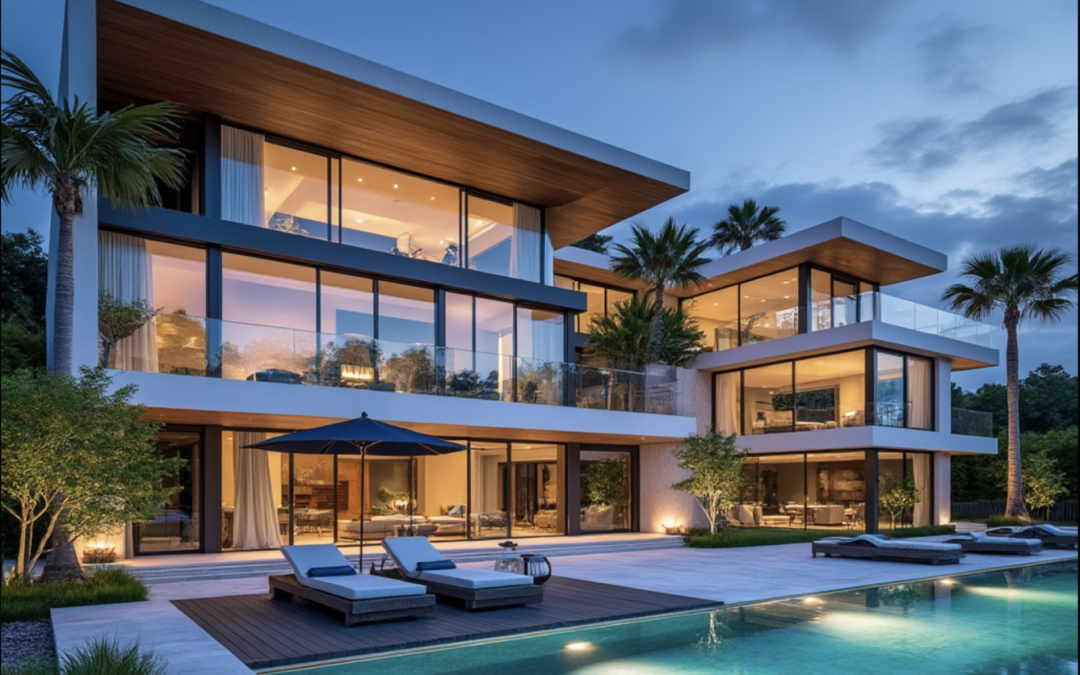
India’s luxury real estate market—homes priced above ₹5 crore—has quietly crossed an inflection point. What was once seen as a speculative, status-driven segment has evolved into a mature, data-led market defined by end-user depth, pricing discipline, and long-term ownership thinking.
This shift is not theoretical. It is visible in how prices behave, how supply is structured, and—most importantly—who is buying. Luxury housing in India no longer operates on hype cycles. It operates on fundamentals.
Luxury Pricing Has Normalised — A Key Marker of Maturity
In emerging markets, luxury prices tend to overshoot, driven by scarcity narratives and speculative demand. In mature markets, luxury behaves differently: it stabilises.
Over the past few years, price premiums between luxury homes (₹5 Cr+) and the broader housing market in Tier-1 cities have compressed marginally, not expanded. This indicates three things:
- Mainstream housing prices have risen steadily
- Luxury pricing has remained rational and controlled
- Volatility at the top end has reduced
This is exactly how mature markets behave. Luxury no longer spikes disproportionately during upcycles, nor does it collapse during slowdowns. Instead, it tracks economic fundamentals and end-user demand.
At the same time, newer luxury corridors outside traditional city cores have seen faster growth in both demand and supply. India now operates as a two-speed luxury market: stabilisation in established markets and expansion in emerging ones. That coexistence is a classic sign of maturity.
Luxury Housing Above ₹5 Cr Is Now Structural, Not Cyclical
Homes priced above ₹5 crore are no longer a fringe category.
Today:
- High-value housing forms a meaningful share of total residential supply
- Properties above ₹5 Cr account for a disproportionate share of transaction value
- Buyer demand in this segment is increasingly end-user led, not investor driven
Developers have structurally reoriented toward this reality:
- Larger homes with fewer units per floor
- Higher baseline specifications (not optional upgrades)
- Stronger emphasis on privacy, security, and livability
On the buyer side, behaviour has changed just as meaningfully. Luxury homes above ₹5 Cr are now being purchased as primary residences, family assets, and legacy holdings. The “buy, flip, exit” mindset that once defined luxury cycles has largely disappeared.
Bengaluru Shows What a Mature ₹5 Cr+ Market Looks Like
Among Indian cities, Bengaluru is one of the clearest examples of this evolution.
Nearly half of the city’s residential value now sits in premium and luxury housing, with a significant portion above the ₹5 Cr mark. This demand is not driven by inherited wealth or speculative capital. It is driven by first-generation balance-sheet wealth.
Startup exits, ESOP monetisation, secondary sales, and repeat entrepreneurship have created a steady pipeline of buyers who:
- Think in long-term capital frameworks
- Separate lifestyle consumption from asset allocation
- Optimise for downside protection as much as upside
Homes in the ₹5–15 Cr bracket in central and established micro-markets continue to see consistent absorption—even during periods when mass-market housing slows. Median luxury prices in Bengaluru now sit close to ₹3 Cr overall, with central pockets and low-density developments comfortably clearing the ₹5 Cr threshold.
What matters more than price is buyer intent. These are end-users buying for 10–20 year horizons, not short-term appreciation.
Expansion Without Dilution: Another Sign of Maturity
Mature luxury markets expand without losing pricing discipline.
In India, demand above ₹5 Cr is no longer limited to a handful of pin codes. Infrastructure-led growth has unlocked new premium corridors:
- Airport-adjacent zones
- Transit-connected urban extensions
- Planned low-density districts
Luxury housing shares in several such corridors have multiplied over recent years. Importantly, this expansion has not diluted the core luxury market. Instead, it has created clear segmentation—with prime micro-markets preserving scarcity and emerging zones building depth beneath them.
That layering is healthy. It strengthens the overall ecosystem.
The Definition of Luxury Has Grown Up
In immature markets, luxury is defined by surface signals: size, marble, and price.
In mature ₹5 Cr+ markets, luxury is defined by:
- Privacy and density control
- Planning quality and long-term livability
- Sustainability and future-ready infrastructure
- Governance, discretion, and low-friction ownership
- How well the asset performs across cycles
Luxury today is less about excess and more about resilience.
What This Means for HNIs and UHNIs
In an emerging market, almost any expensive home can look like a good bet.
In a mature luxury market, that assumption breaks.
For HNIs and UHNIs buying above ₹5 Cr, the real filters now are:
- Micro-market depth and long-term relevance
- End-user demand at similar ticket sizes
- Supply discipline and density
- Developer credibility and execution history
- Exit resilience over a full cycle
India’s luxury real estate market has grown up.
And in grown-up markets, discernment replaces speculation.
Closing Thought
India is no longer “becoming” a luxury real estate market.
It already is one.
Homes priced above ₹5 crore today sit in a stable, end-user-driven, structurally mature ecosystem. Cities like Bengaluru show what this maturity looks like: rational pricing, steady absorption, and buyers making long-term decisions with clarity.In this environment, luxury is not about access.
It’s about choosing the right asset—and holding it well.